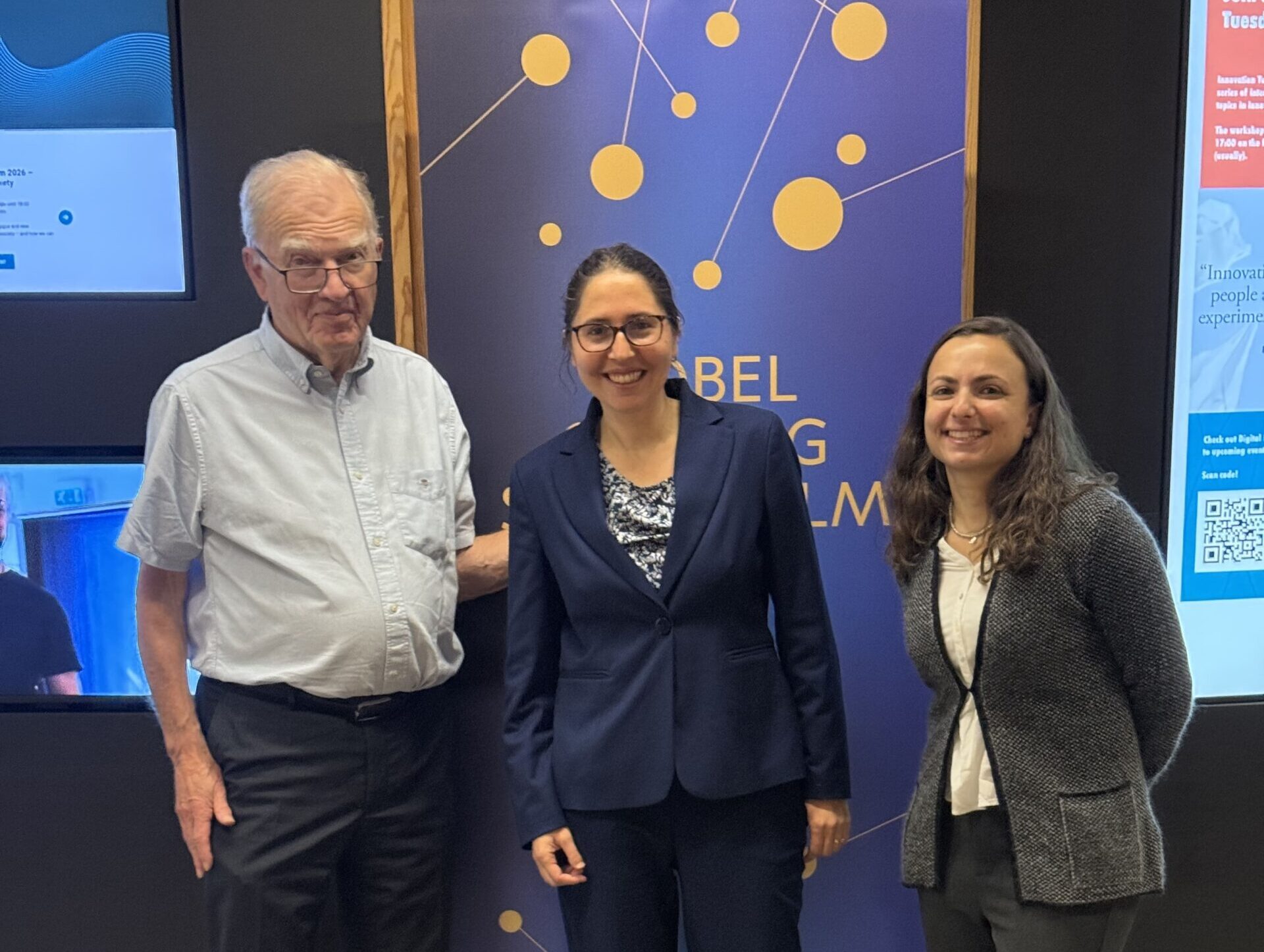
From August to December 2024, Lucca Geurts, Associate Professor at KU Leuven (Belgium), is joining Digital Futures as a Scholar in Residence. Lucca brings extensive expertise in Human-Computer Interaction, with a focus on designing interactive sensor-actuator systems that incorporate tangible and playful elements. Lucca’s work spans diverse domains such as health, learning, arts, and entertainment, often collaborating with healthcare professionals and artists to create meaningful technologies for vulnerable groups, including children with developmental disabilities and underserved communities.
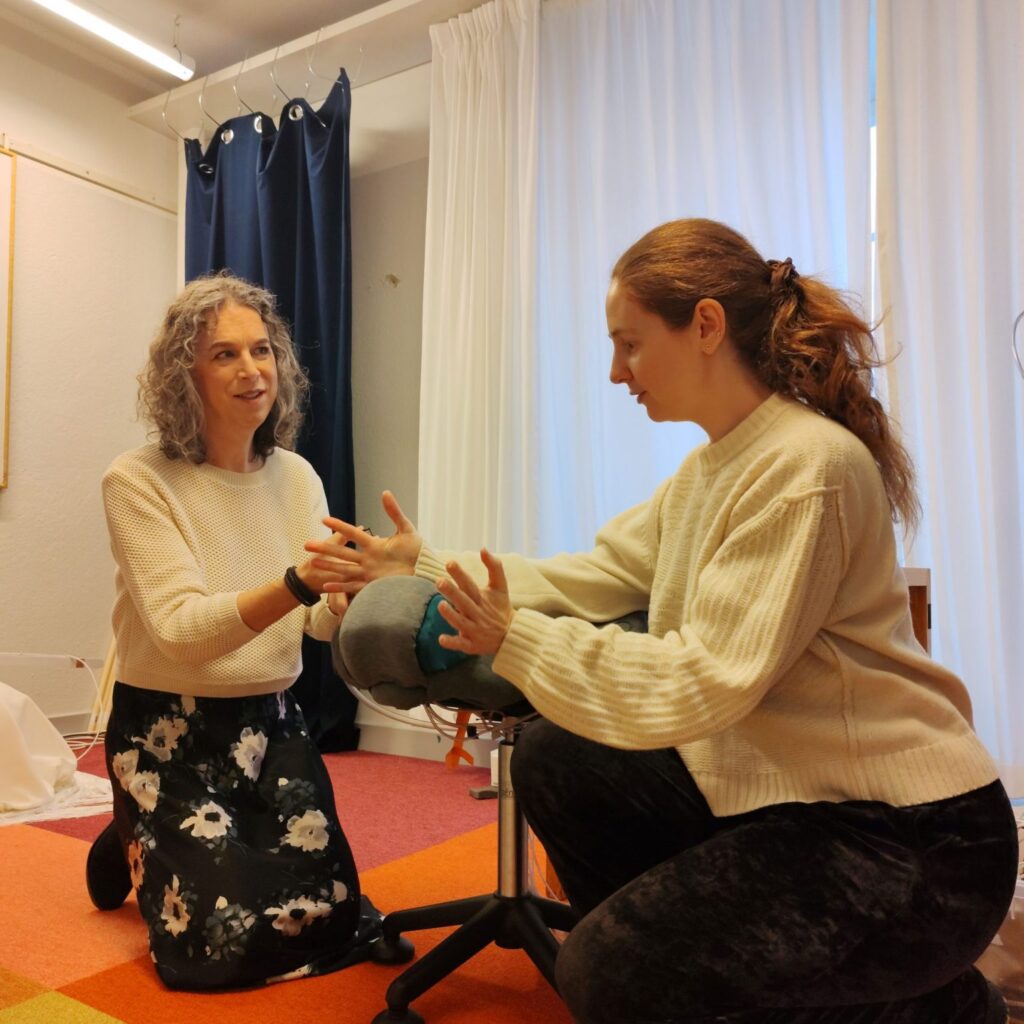
In action – Lucca Geurts and Madeline Balaam with the Pelvic Chair
At Digital Futures, Lucca is hosted by Professor Madeline Balaam in the Media Technology and Interaction Design Department. Together, they are exploring innovative designs for technologies that engage with the human body, such as the soft robotics pelvic chair, which promotes awareness of pelvic floor anatomy. Lucca’s residency offers a unique opportunity to integrate new perspectives and methodologies, including somaesthetic design, into future research and teaching at KU Leuven.
At a highly anticipated seminar hosted by Madeline Balaam at the Digital Futures Hub on 21 November 2024, Lucca Geurts discussed Digital Technologies as Solutions for Health Challenges in the Global South. You can watch the recorded presentation on YouTube. Click here to watch!
Hi Lucca, in August you joined Digital Futures as a Scholar in Residence. What drew you to this opportunity, and how does it align with your work at KU Leuven?
– My home university encourages professors to take sabbatical leave, and for me, this was the perfect opportunity to refresh my perspectives and deepen my research. While searching for a suitable host institution, I came across Madeline’s work on interactive systems for health and well-being, which significantly overlaps with my research on tangible and playful systems for health. I was particularly drawn to her current projects on intimate technologies and curious about the methods she uses to design them.
Your research spans health, learning, arts, and entertainment, with a focus on interactive sensor-actuator systems. What inspired you to work across such diverse domains, and what connections do you see between them?
– My inspiration mainly came from the people who approached us. Since we established our research lab, we’ve been contacted by health professionals, educational specialists, and artists, and these encounters have led to exciting and challenging opportunities. At first glance, these domains may seem distinct, but they all involve designing engaging interactive systems, often using similar methodologies and technologies. Working with artists, for example, has shown us alternative ways of doing things, which in turn inspires us to explore novel approaches when designing solutions for specific diseases or disabilities.
During your residency, you’ve been collaborating on projects like the pelvic chair using soft robotics. Could you tell us more about this project and how it fits into your broader research on technologies that touch the body?
– All credit goes to Madeline and her group for designing and developing the pelvic chair. It’s literally a chair you sit on, with soft actuators that touch different parts of your pelvic floor muscles, creating greater awareness of this part of your body. Together with other team members, I’m exploring how to make the chair interactive, allowing users to have more control over how they are touched. I bring expertise in tangible and embodied interaction, but this is my first time working with this type of actuation. In my past projects, the focus was on users touching objects; now, the object is touching the user.
You frequently work with vulnerable groups, such as children with developmental disabilities or people in underserved areas. How has this focus shaped your approach to designing and implementing technology?
– It has shaped my approach significantly. The first step is to set aside any preconceptions and begin with an open and curious mind. In the field of Human-Computer Interaction, it’s common to start with user and task analyses to better understand end users’ needs and their context. In general, we’ve found that these groups are quite eager to collaborate with us and actively contribute to designing solutions that address their needs.
Your time in Sweden involves engaging with the Media Technology and Interaction Design Department and participating in research seminars. What has the experience been like, and what insights or collaborations have stood out so far?
– So far, it has been an incredible experience. The projects they are working on and their approaches to design are highly inspirational. Before this, I wasn’t familiar with somaesthetic design principles or designing from a first-person perspective, but now I plan to incorporate these principles into my future projects. Another standout aspect has been the high level of engagement among researchers. Everyone collaborates and discusses ideas with one another, fostering a culture of collective growth. This group envisions the future and actively creates designs to shape it.
Not to be missed! Lucca Geurts’ talk about Digital Technologies as Solutions for Health Challenges in the Global South. Watch it on Youtube! Click here to watch!
Text: Johanna Gavefalk