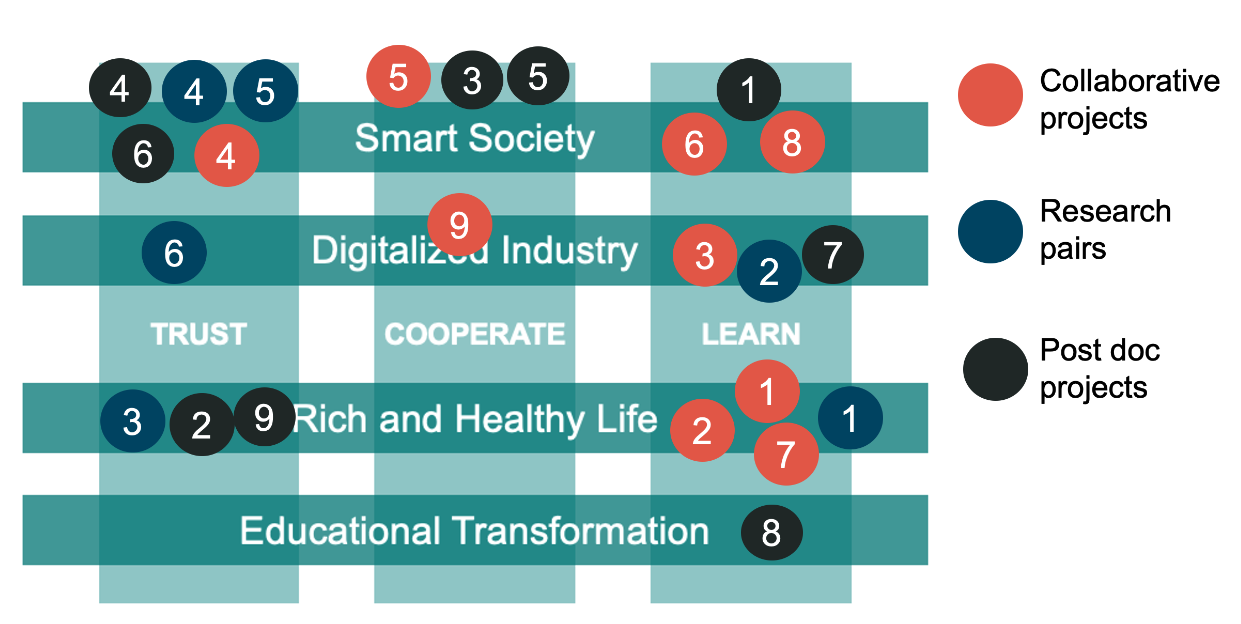
Since its inauguration last year, Digital Futures has had several calls for proposals and more than twenty cross-disciplinary projects with international research teams are now up and running. The illustration above shows which intersections of the Digital Futures research matrix each project primarily addresses.
Nine pilot research projects have evolved into Collaborative projects the will run for four years, involving nearly 50 established research leaders and their respective research teams. They focus on a range of issues from digital assistants in elderly care and sensitive data handling, to smart solutions for water distribution and programmable robotic microscale material. Read more here.
Collaborative projects
- Advanced Adaptive Intelligent Systems
- d-Brain: Digitizing Brain Data for Health and Disease
- Data-Limited Learning of Complex Dynamical Systems
- DataLEASH: LEarning And SHaring under Privacy Constraints
- Democritus: Decision Making in Critical Societal Infrastructures
- EO-AI4GlobalChange
- EXTREMUM: Explainable and Ethical Machine Learning for Knowledge Discovery from Medical Data Sources
- Humanizing the Sustainable Smart City (HiSS)
- Robotic Matter
There are also six Research pairs breaking new ground in areas ranging from improving the diagnosis and treatment of anxiety disorders to designing threat models for cyber insurance. The funding instrument Research pairs is intended to foster collaboration between two young researchers that have obtained their doctoral degrees, not more than ten years ago. The instrument is aimed to identify new research collaborations that can develop into a leading scientific activity over the next few years. It is a vehicle for supporting and promoting young scholars with the potential to become future digital leaders. Read more here.
Research pairs
- Characterization of the mechanical tissue properties of the brain in the developing brain with magnetic resonance elastography
- Enabling Machine-Learning Intelligence for NetworkCybersecurity
- Layering Trust in Intimate Digital Health Technologies
- Resilient Decentralized Computing: Enabling Trust and Simplicity in Smart Edge Services
- SOS: Empowering User Control over Sensitive IoT Data
- Threat models for cyber insurance
In addition, nine Postdocs projects are currently part of the Digital Futures’ mobility program for talented early-career researchers, with two supervisors each from the Digital Futures faculty. Their research covers topics like Digital Transformations for Optimising the Post-Pandemic Sustainable Smart City, Fusion of Radar and Optical Remote Sensing Time Series for Wildfire Monitoring with Deep Learning, Feminist Design of Social Robots and Designing Robots For Young People, With Young People. Read more here.
Postdoc projects
- Deep Learning Approaches for Long-term Future Forecasting
- Digital Transformations for Optimising the Post-Pandemic SustainableSmart City
- Distributed Optimization and Federated Learning in Emerging Smart Networks
- Foreignness as conceptual framework for interaction design
- Fusion of Radar and Optical Remote Sensing Time Series for WildfireMonitoring with Deep Learning
- How people are making the city smart – the role of algorithms in urban space
- Intelligent wireless communications and high-accuracy positioning systems
- Learning Analytics in Higher education
- On The Feminist Design of Social Robots and Designing Robots For Young People, With Young People
With ongoing calls and evaluations of demonstrator projects, diversity and inclusion projects and additional postdoc projects, the Digital Futures research programme will soon expand, even more, we’ll keep you posted.