Research centre established by:

KTH, Stockholm University and RISE
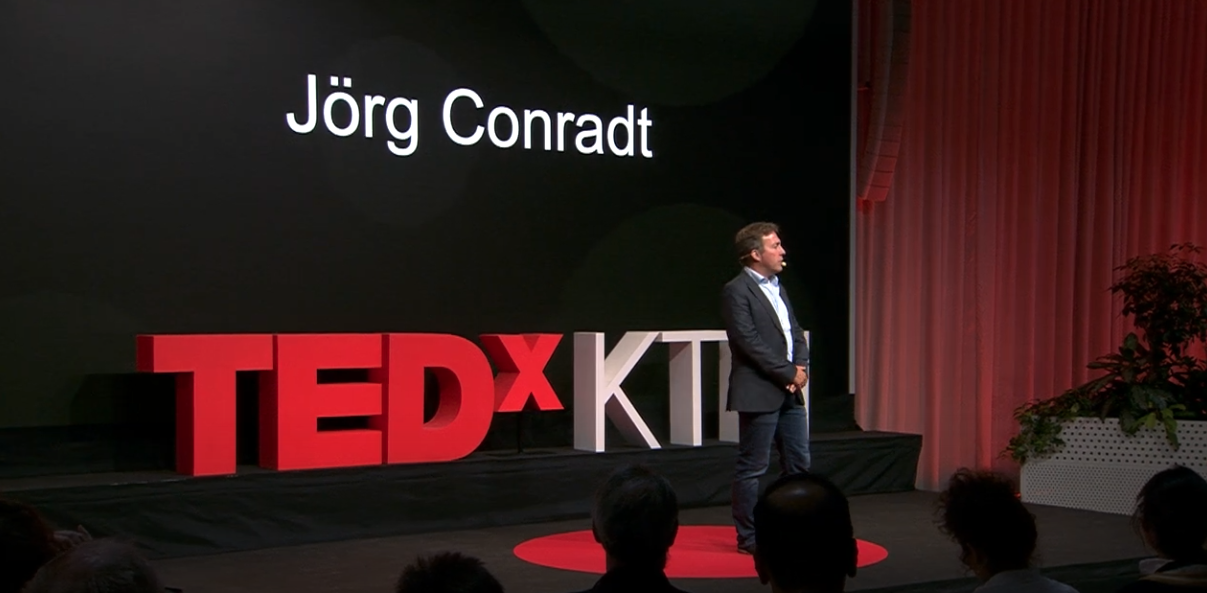
A speaker stands on stage in front of a large screen displaying the name Jörg Conradt at a TEDxKIT event. The stage features red and white TEDx letters and is decorated with plants.

Energy-efficient Neuromorphic Computing – TEDx-talk by Jörg Conradt is now Youtube

Digital Futures faculty member Jörg Conradt is an Associate Professor at the School of Electrical Engineering and Computer Science at KTH and a leading researcher in neuro-inspired computation and systems. With a PhD from ETH Zurich, Jörg is deeply fascinated with how brains process sensor information and form a consolidated understanding of the world around us. Before KTH, he was a Junior Professor at Technische Universität München, where he co-founded the Elite Master Program in NeuroEngineering.

In his TEDx talk ”Energy-efficient Neuromorphic Computing”, Jörg delves into the intriguing question of how our brains process information, i.e., how we interpret what we see, hear, smell, and touch, and how these processes differ from how computers operate today. He highlights how energy-efficient computing strategies brains have developed and demonstrates how to use them for pervasive sensors, mobile computers, and small autonomous robots.

“TEDxKTH – our digital futures” was organized by Digital Futures at Ericsson Open Box, Kista, on 3 September 2024.
More news

A panel of four people seated on a stage at the Nobel Prize Museum in front of an audience.

Does AI make us stupid? Experts explore how AI is changing human abilities

06/10/2026

As artificial intelligence becomes part of research, education, workplaces and everyday life, an important question...

French business delegation explores Sweden’s collaborative innovation model

02/10/2026

On 29 September, Digital Futures welcomed Business Sweden and a delegation of French industrial leaders...

A woman with curly hair in a black blazer and white shirt smiles, leaning on a pink chair in a bright, modern office space with large windows in the background.

WASP secures continued funding through 2034

21/09/2026

The Wallenberg AI, Autonomous Systems and Software Program (WASP) will continue through 2034, following a...

A man in a grey shirt and jeans stands smiling in a modern office corridor with wooden walls, a blackboard covered in writing, and a window labelled digital fut.

Paul Walton reflects on an interdisciplinary stay at Digital Futures

18/09/2026

As his time as Scholar-in-Residence at Digital Futures comes to an end, Professor Paul Walton...