In a groundbreaking study, Kerem Kaya and others in the team of Digital Futures researchers Danica Kragic and Wouter van der Wijngaart have unlocked the full potential of programmable matter by introducing a cutting-edge method called “solid-liquid phase change pumping.” Overcoming limitations in existing approaches, this innovative technique allows for free-form transfiguration and autonomous movement of solid objects with sub-millimetre precision.
The study entitled “Programmable Matter with Free and High-resolution Transfiguration and Locomotion” (Article DOI: 10.1002/adfm.202307105) was published on 24 December 2023 in the high-impact journal Advanced Functional Materials.
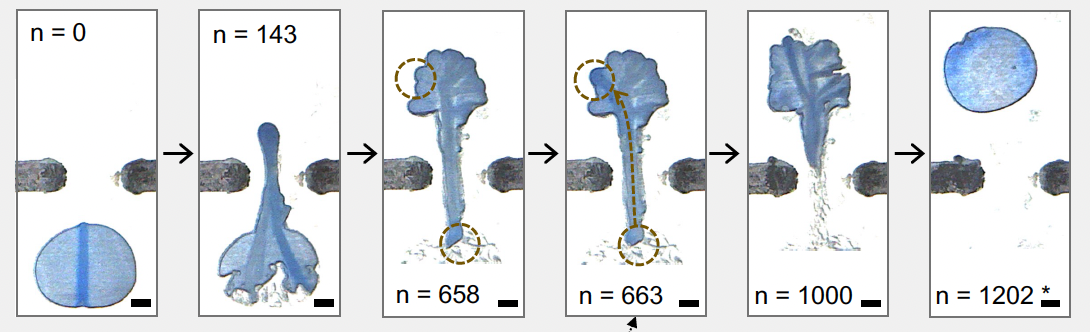
Unlike previous methods constrained by shape freedom and resolution, solid-liquid phase change pumping offers a unique path towards a programmable material with unparalleled freedom in shape and autonomy. The ability to transform thin objects into any desired shape, change topologies (e.g., add or remove holes, split, merge), and navigate through narrow spaces without direct contact opens the door to transformative applications.
– I believe our findings are of a rather spectacular nature, as we are the first to show contactless reshaping of objects, without limitations, in 2D, says Wouter van der Wijngaart, Professor of Micro and Nanosystems at the Dept of Intelligent Systems at KTH Royal Institute of Technology.
The study focuses on creating programmable matter capable of free-shape transfiguration and locomotion, introducing a novel method that propels solid objects into dynamic motion. Solid-liquid phase change pumping, in short, melts a tiny fraction of a solid object, transports the molten material pocket through the solid object, and resolidifies the material at another position in the object. This technique enables the step-by-step deformation of objects at a sub-millimetre level, allowing for intricate and precise shape changes and transport of the object itself.
Objects can be manipulated through narrow constrictions before being seamlessly restored to their original form.
– The implications of this breakthrough are vast, with potential applications in “hard-to-reach” environments. Just think about such as space exploration, deep underground excavations, and deep-sea operations, explains Kerem Kaya, PhD student in the same Department. The ability to repurpose objects without direct contact becomes crucial in scenarios where physical access is challenging or impossible.
– Also, think about scenarios where material supply or removal is costly, such as adapting living spaces. The ability to reshape objects instead of replacing them could revolutionize industries dealing with expensive materials, offering a sustainable and cost-effective solution, continues Danica, Professor of Robotics in the same Department.
The researchers have so far demonstrated their approach on materials that are easy to melt and resolidify, such as certain plastics. Current efforts focus on speeding up the transformation and extending shape transformation from two to three dimensions.
According to the researchers, solid-liquid phase change pumping offers potentially transformative solutions in various fields.
– This technology could lead to advancements that were once deemed impossible. The potential for full topological shape freedom and autonomous movement opens new doors for innovation – from space missions to reconfiguring living spaces, concludes Wouter. The world awaits the practical implementation of this groundbreaking technology, which could redefine how we interact with the physical world, pushing the boundaries of what is possible in shape-shifting materials and autonomous object manipulation.
Link to the publication “Programmable Matter with Free and High-resolution Transfiguration and Locomotion” in the journal “Advanced Functional Materials”.