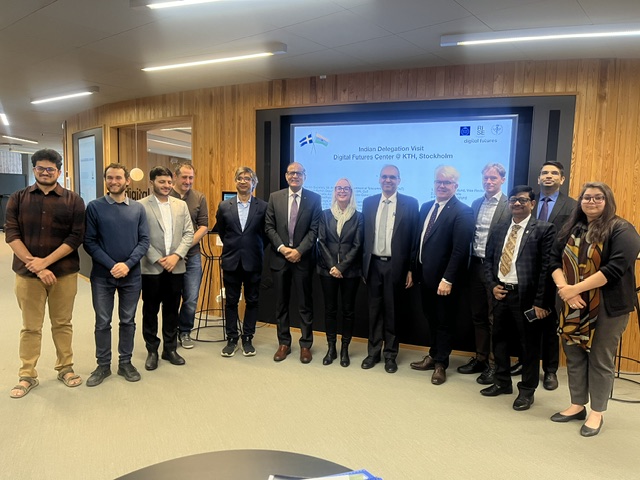
A new strategy puts human agency, responsible AI, and collaboration at the heart of digital transformation.
Digital technologies are reshaping every aspect of society. Artificial intelligence, data-driven systems, and connected infrastructures are creating unprecedented opportunities to improve healthcare, education, industry, cities, and public services. At the same time, these technologies raise critical questions about trust, responsibility, sustainability, and the role of humans in an increasingly digital world.
With its new Strategic Plan 2026–2030, Digital Futures charts an ambitious course for the next five years: to accelerate the journey from scientific discovery to societal impact.
Developed under the leadership of Pawel Herman, Associate Director Strategic Research, together with the Digital Futures Executive Committee and the broader research and partner community, the strategy builds on the centre’s achievements since its launch in 2020 while sharpening its focus on real-world implementation.

“Our ambition is to move beyond producing excellent research to ensuring that this research creates real societal value. By integrating research, experimental arenas and innovation, we are building a stronger bridge from science to impact – always with human agency and trustworthy AI at the centre,” says Pawel Herman.
A strategy built around impact
At the core of the new strategic plan is an integrated model that connects three mutually reinforcing pillars:
- Research – generating new scientific knowledge and technological breakthroughs.
- Experimental Arenas – creating environments where ideas can be tested and refined under real-world conditions.
- Innovation – translating research outcomes into scalable solutions, entrepreneurship, and societal value.
By strengthening the interaction between these pillars, Digital Futures aims to shorten the path from laboratory discoveries to practical deployment and long-term benefit for society.
The strategy recognises that scientific excellence alone is not enough. Future breakthroughs require close collaboration across academia, industry, and the public sector, bringing together expertise and perspectives to tackle complex societal challenges.
Human agency in the age of AI
A defining feature of the 2026–2030 strategy is its emphasis on human agency. Rather than viewing technology as an end in itself, Digital Futures positions digital transformation as a means to empower people, strengthen institutions, and foster a sustainable and inclusive society.
Artificial intelligence will act as a catalyst across the centre’s activities, but its development and deployment must be responsible, transparent, and trustworthy. The strategy therefore places strong emphasis on ethical responsibility, human-centred system design, and the development of AI that enhances—rather than diminishes—human capability.
This perspective extends across the entire research agenda, which combines four societal contexts—Smart Society, Digitalized Industry, Rich and Healthy Life, and Educational Transformation—with three scientific themes: Trust, Cooperation, and Learning.
Building environments for collaboration
A major new focus for the coming years is the development of Experimental Arenas—collaborative spaces where researchers, companies, public organisations, and citizens can jointly explore and validate digital innovations.
Among the flagship initiatives are:
- the Stockholm Digital Sandbox, a testbed for AI and digital innovation;
- the Stockholm Urban Innovation Lab, connecting research with sustainable urban development;
- the Digital Health Environment, supporting trustworthy AI in healthcare and medicine; and
- the Educational Arena, where AI-enabled learning solutions can be co-designed and evaluated in ethically governed settings.
Together, these arenas will provide the infrastructure needed to bridge the gap between research and implementation.
Strengthening Sweden’s digital future
Since its establishment, Digital Futures has grown into a unique partnership bringing together universities, research institutes, industry leaders, and public-sector organisations. The new strategy reinforces this collaborative model by deepening engagement with industrial partners, expanding support for entrepreneurship and spin-offs, and strengthening links to innovation ecosystems.
Ultimately, the 2026–2030 Strategic Plan is about ensuring that digital transformation creates lasting value—not only through scientific breakthroughs, but by addressing pressing societal needs and improving everyday life.
As Digital Futures enters its next strategic phase, its guiding principle remains clear: digital technologies should strengthen human capability, foster trust, and contribute to a sustainable and inclusive future.