Date and time: Thursday 3 September 2026, 14:00-15:00 CEST
Speaker: Taniya Kapoor, Wageningen University & Research in the Netherlands
Title: Rethinking Scientific Machine Learning: From Accuracy to Sustainability
Where: Digital Futures hub, Osquars Backe 5, floor 2 at KTH main campus OR Zoom
Directions: https://www.digitalfutures.kth.se/contact/how-to-get-here/
OR
Zoom: https://kth-se.zoom.us/j/69560887455
Host: Francisco Javier Vilaplana Domingo franvila@kth.se
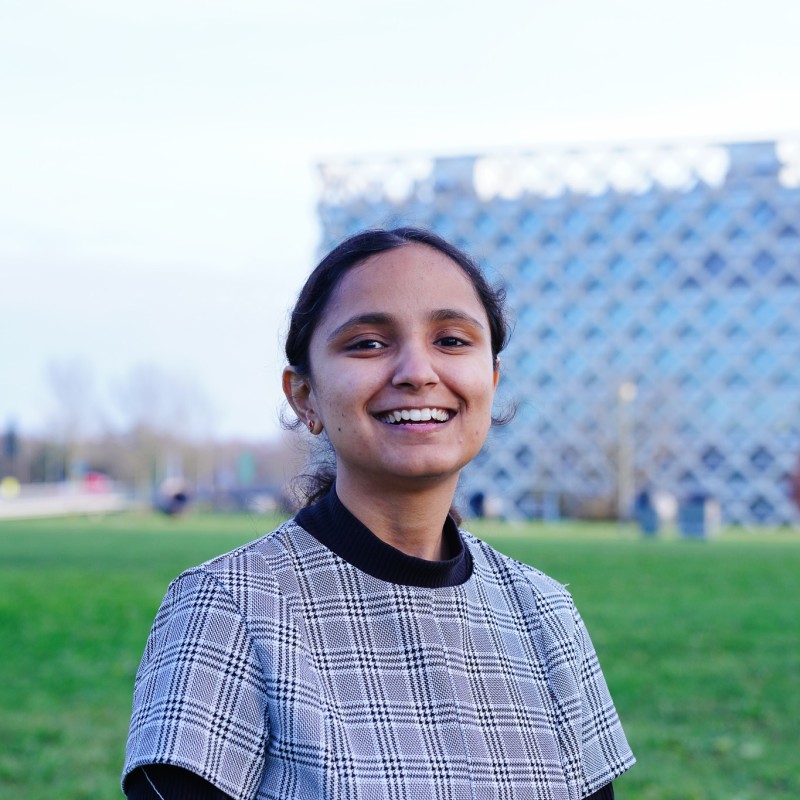
Bio: Taniya Kapoor is an Assistant Professor in the Artificial Intelligence Group at Wageningen University & Research in the Netherlands. Her research focuses on AI for science, with particular attention to two key challenges: limited data and computational cost.
She develops physics-informed and engineering-informed machine learning methods that integrate physical knowledge, simulations, and data to build more reliable and efficient AI models. Prior to this position, she was awarded an AI Schmidt Postdoctoral Fellow at the University of Oxford and completed her PhD and postdoctoral research at TU Delft, where she worked on generalization in physics-informed machine learning.
Tanya is a Digital Futures SEC scholar from 3 August to 15 September 2026.
Abstract: AI is getting very good at solving scientific problems. It can predict how physical systems behave. Methods like Physics Informed Neural Networks and operator learning are widely used for this. But there is a hidden cost. These models need a lot of computation. This leads to high energy use and carbon emissions. Most of the time, we only measure accuracy. We ignore the environmental impact. In this talk, we ask a simple question. What if we measure both accuracy and carbon cost? We introduce EcoL2. It is a new metric for scientific machine learning. It measures how well a model performs and how much carbon it produces across its full lifecycle.
Our results show something important. Two models can have similar accuracy. But one can use much more energy than the other. This is true for PINNs and operator learning methods. Accuracy alone is not enough. We need better ways to compare models. This talk encourages a new direction. Build models that are accurate, efficient, and environmentally responsible.