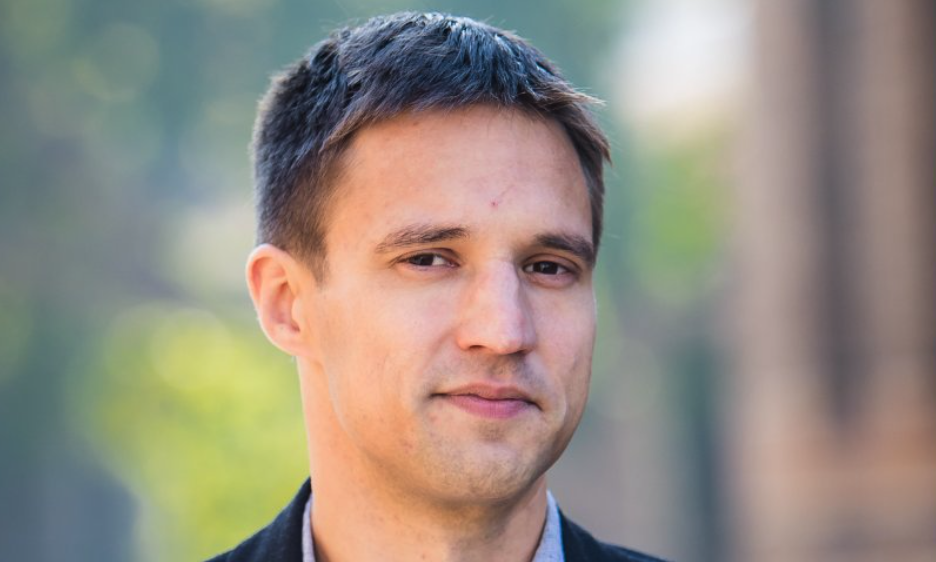
Simon Knight is the Director of the University of Technology Sydney, Centre for Research on Education in a Digital Society (UTS: CREDS), previous co-editor-in-chief of the Journal of Learning Analytics, and Australian Research Council, Discovery Early Career Award (DECRA) Fellow. His research draws on his interdisciplinary background. He holds a BSc in Philosophy and Psychology, a Master in Philosophy of Education and Educational Research Methods, and a PhD in Learning Analytics, alongside university and high-school teaching qualifications.
Hi Simon, you just arrived in Stockholm as a Digital Futures scholar-in-residence. What made you take on this opportunity?
– My work is at the intersection of learning and digital technologies, so it was a great opportunity to be at Digital Futures and think about the issues of Digital Transformation with colleagues tackling questions from different approaches. I’ve been collaborating over the last couple of years with colleagues in Digital Futures – Olga Viberg, Teresa Cerratto Pargman, and Cormac McGrath – thinking about Responsible Learning Analytics from a practical and theoretical perspective, so the scholar-in-residence program was a chance to work more closely together – and to meet in person!
Your research focuses on how people learn to navigate uncertainty, disagreement, and evidence and the mediating role of technology in that. Why do you find this so fascinating?
– Think about the decisions you make around big issues like sustainability and health. You make personal choices – which product to buy, how to act, talk about these with people, and express preferences for policies. Across all these, is there ever 100% certainty? Or 100% consensus? We know that people encounter these issues all the time, and that they often find it challenging to understand why experts disagree, which can lead to distrust in expertise more generally. My research investigates how people learn to Navigate Uncertainty, Disagreement, and Evidence, by analysing the processes of searching for, evaluating, and synthesising claims through technology. We must learn strategies to have constructive disagreement that builds on evidence, is respectful but avoids bothsidesism, and that reflects scientific uncertainty but avoids uncertainty-hesitancy. Scientific and data literacy are fundamental to tackling our biggest societal challenges. However, while understanding key concepts or content is important, understanding the nature of science and knowledge – including scientific uncertainty, and why experts may disagree – are also crucial.
My research uses psychological theory – epistemic cognition – which models beliefs about knowledge, alongside analyses of how we ‘think together’ through dialogue, to ethically reason about that evidence. People sometimes focus on the negative of technological polarisation, but my research investigates how technology and data can be used to analyse and support learning, through well designed teaching. I’m keen to hear about people’s work so do get in touch if you’d like to chat over afternoon “fika” if appropriate.
Here at Digital Futures, you will focus on how people learn to engage ethically with AI by investigating and developing guidelines and cases to support ethical practice – tell us more about this.
– Recent years have seen a proliferation of guidelines, principles, and design approaches for navigating the ethics of AI across a wide range of domains from academia, industry, rights groups, and governmental and supranational organisations. This has included application to education, which has received particular attention within research, from institutions as they seek to adapt – in varying ways – to a range of challenges. How do people learn about, with, and for these materials? How do people learn to navigate the nuanced ethical concerns that arise in application of technology to learning, and develop approaches (and material resources) to support this? It is not hard to find controversies, examples of bad practice and harms, however, a micro-ethics approach seeks to understand the moment-to-moment ethical judgements made – here, in the context of data production, analysis, and use – and their implications. The research focus over this period will investigate approaches and example resources, seeking to develop guidelines to support resource creation to support learning to engage ethically with AI.
You seem very active – on top of the teaching and research, you co-chair conferences, review journals and much more. And you’ve travelled around the world – Australia, USA, United Kingdom, and now Sweden – from where do the energy and curiosity come?
– I’ve been very fortunate to receive support to participate and lead in a number of contexts, including receiving a period of sabbatical from the University of Technology Sydney (UTS) corresponding with part of my Digital Futures residency. I’m also now a dual citizen – Australia and the UK – so I’m fortunate to have work and personal ties across continents and it’s important for me to be able to nurture them. The service roles I’ve had have been incredibly rewarding both because of the fantastic colleagues I’ve worked with, and exposure to people’s ideas through conferences, etc.; taking those roles on allows me to act as a catalyst in shaping parts of the field.
Finally, tell us a little about yourself. What have you done in Stockholm so far? Any place you would like to visit while in Sweden?
– On my second day in Stockholm I ran 25 km around the city – seems a pretty good way to see the place to me! I’m enjoying working my way through the cardamom of Stockholm.
Your scholarship ends in June – what will you do next?
– After Stockholm I’ll be heading back to Sydney to commence my DECRA Fellowship, which means late 2023 will be my first full Summer since 2021/22. Summer for the Southern Hemisphere takes place from December to January. The plan is to continue the collaborations with Digital Futures and at the UCL Institute of Education in London, where I hold an honorary Associate Professorship, so we can both wrapup the work over my residency, and hopefully work with stakeholders to consider impact in different settings.