About the project
Objective
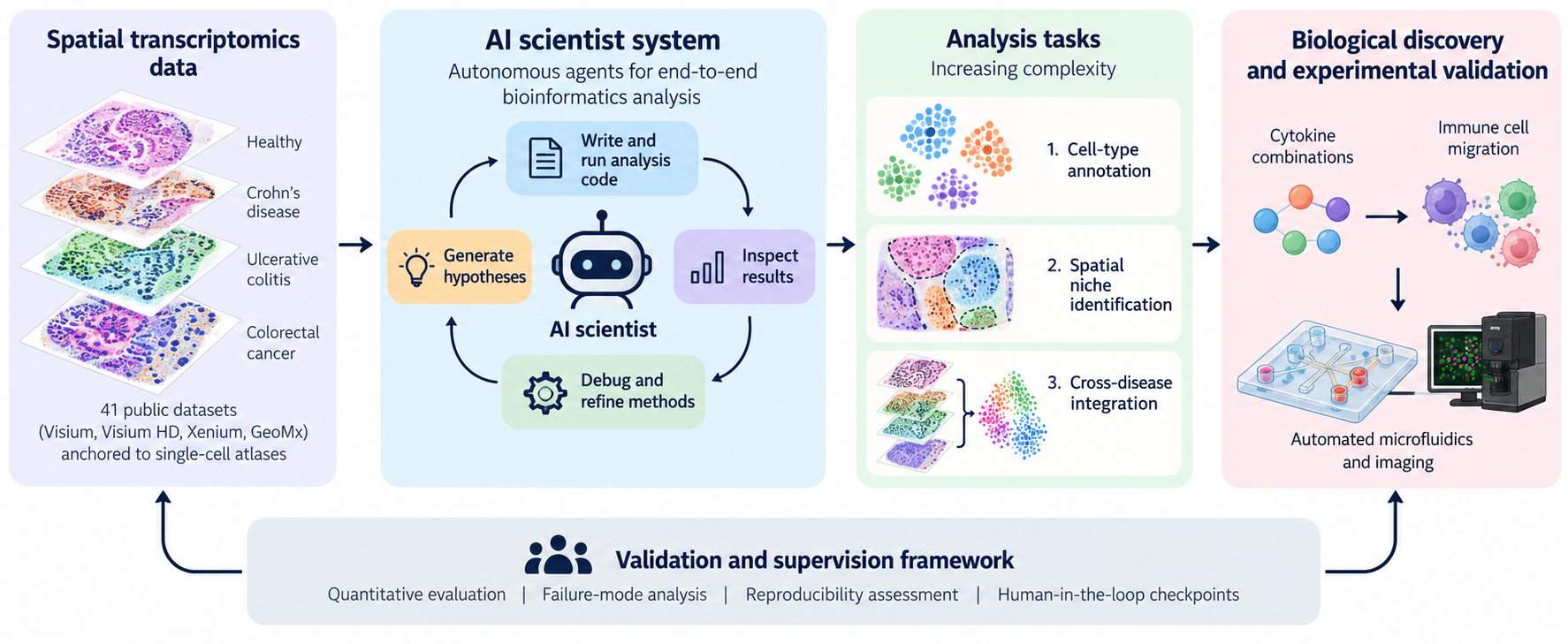
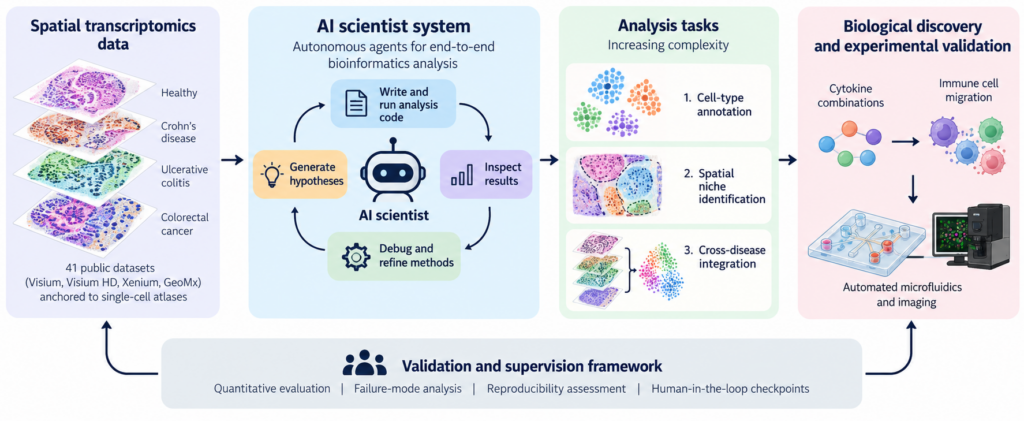
This project aims to develop autonomous AI scientist systems for bioinformatics analysis of spatial transcriptomics data. Building on general-purpose AI models, these systems will independently write and execute code, critically evaluate results, refine analytical methods, and generate biological hypotheses about cellular architecture of human tissues. We will compare single-agent and multiagent approaches and establish methods for evaluating accuracy and reliability under human expert supervision. By applying these systems across gastrointestinal diseases, we aim to accelerate biomedical research in mucosal immunology, exploring how AI advances can contribute to scientific discovery in the life sciences.
Background
Spatial transcriptomics map gene expression and cellular interactions within human tissues, providing unprecedented insights into health and disease. However, rigorous data analysis requires extensive computational expertise and workflow optimization to curate data and accurately model cellular behaviour, which limits large-scale analysis of publicly available spatial transcriptomic data. In contrast, meta-analysis of single-cell gene expression data has been caried out at scale by the Human Cell Atlas consortium across many human organs, but studies of spatial transcriptomics data are lacking.
Recent advances in AI offer opportunities to automate scientific data analysis and discovery. To test this, the project will use 41 publicly available spatial transcriptomics datasets from healthy intestinal tissues, inflammatory bowel disease, and colorectal cancer to benchmark autonomous AI scientists. The tasks include cell type annotation, niche identification, and cross-disease integration, modeling cell states, niches, and technical biases from diverse spatial transcriptomic platforms. Beyond identifying cell types and tissue structures, the project will investigate whether AI can generate novel biological predictions about immune cell migration, which will be tested experimentally with automated cytokine perturbations.
Crossdisciplinary collaboration
The project establishes a cross-departmental collaboration between the labs of Simon Koplev and Wei Ouyang, combining expertise in computational biology, mucosal immunology, spatial transcriptomics, agentic AI, and automated microscopy. Koplev’s group will lead the biological data integration, benchmarking, and interpretation, while Ouyang’s group will develop autonomous AI systems and experimental validation workflows. Together, the research will establish AI-assisted biomedical discovery of cells and niches in the human gut, connecting computational analysis with automated biological experimentation. Concretely, the successful establishment of a reference spatial transcriptomic dataset for the human gut would represent a foundational data resource for the gastrointestinal research community, promoting cross-disciplinary inquiry across studies and gastrointestinal diseases.