Date and time: Tuesday 12 May 2026, 14:30-15:30 CEST
Speaker: Srinivasan Keshav, University of Cambridge
Title: Democratizing Earth Observation with Foundation Models: The TESSERA Project and Embedding Explorer
Where: Digital Futures hub, Osquars Backe 5, floor 2 at KTH main campus OR Zoom
Directions: https://www.digitalfutures.kth.se/contact/how-to-get-here/
OR
Zoom: https://kth-se.zoom.us/j/69560887455
Host: Yifang Ban, yifang@kth.se
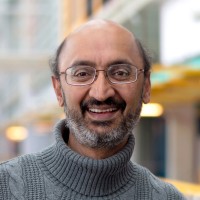
Bio: Srinivasan Keshav is the Robert Sansom Professor of Computer Science in the Department of Computer Science and Technology at the University of Cambridge. His interests lie broadly at the intersection of computer science and sustainability. He received a B.Tech in Computer Science and Engineering from IIT Delhi in 1986 and a Ph.D. in Computer Science from the University of California, Berkeley in 1991. He was subsequently a Member of Technical Staff at AT&T Bell Labs and an Associate Professor at Cornell. In 1999 he left academia to co-found Ensim Corporation and GreenBorder Technologies Inc.
Returning to academia, he was at the University of Waterloo in Canada from 2003 to 2019, holding a Canada Research Chair and later the Cisco Chair in Smart Grid. He is a Fellow of the Royal Society of Canada, ACM, and IEEE, and a Distinguished Alumnus of IIT Delhi. He has served as Chair of ACM SIGCOMM and founding Vice-Chair of ACM SIGEnergy.
Abstract: Foundation models for Earth observation (EO) promise to transform how we monitor and understand our planet, yet the computational cost of training and deploying such models risks concentrating their benefits among a small number of well-resourced institutions. In this talk, I present TESSERA, a foundation model for Earth observation that generates rich semantic embeddings from Sentinel-1 and Sentinel-2 imagery at 10-metre global resolution. I discuss the architectural and data engineering choices underpinning TESSERA, situating them within the rapidly evolving landscape of EO foundation models, and highlight the downstream tasks — from deforestation detection to habitat mapping — that these embeddings support.
A key ambition of the TESSERA project is to make state-of-the-art EO embeddings freely and practically accessible to researchers, policymakers, and conservation practitioners worldwide, including those without access to large-scale GPU infrastructure. To this end, I demonstrate the TESSERA Embedding Explorer (TEE), a lightweight, browser-based tool that allows users to interactively visualize, query, and analyse TESSERA embeddings over any region of interest without requiring specialized hardware or software. I discuss how tools like TEE can lower the barrier to entry for sophisticated geospatial analysis and reflect on the broader challenge of operationalizing foundation model outputs for real-world environmental decision-making.