Date and time: Thursday 15 October 2026, 12:00-13:00 CEST (arrive at 11:45 for FREE LUNCH*)
Speaker: Prof. Mason A. Porter, Nordic Institute for Theoretical Physics / Stockholm University
Title: Opinion Dynamics on Networks
Where: Digital Futures hub, Osquars Backe 5, floor 2 at KTH main campus OR Zoom
Directions: https://www.digitalfutures.kth.se/contact/how-to-get-here/
OR
Zoom: https://kth-se.zoom.us/j/69560887455
*To get a FREE LUNCH, you need to register — first come, first served. Maximum 50 participants.
The hub will be open 30 minutes before and after the event for those who wish to stay longer.
Host: Martina Scolamiero scola@kth.se
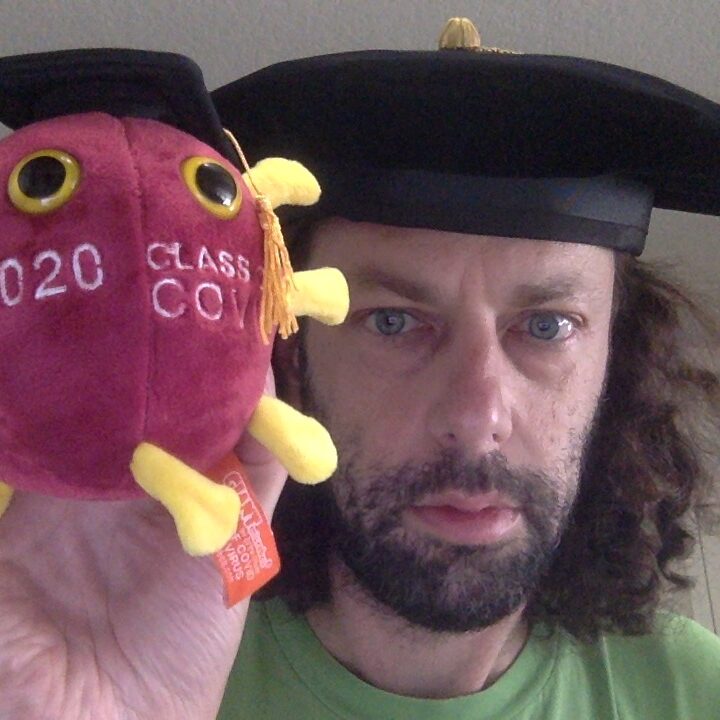
Bio: Mason A. Porter earned his undergraduate degree in applied mathematics from Caltech in 1998 and his PhD from Cornell in 2002. After postdoctoral positions at Georgia Tech and Caltech, he joined the faculty of University of Oxford.
He moved to UCLA in 2016. Since September 2026, he has been a Professor at the Nordic Institute for Theoretical Physics (Nordita) and Professor in Complex Systems in the Department of Mathematics at Stockholm University. He is a Fellow of the American Mathematical Society, the American Physical Society, the Society for Industrial and Applied Mathematics, and the Network Science Society.
Abstract: In mathematical models of opinion dynamics, individuals interact with each other and adjust their opinions based on their interactions. In opinion models, network structures determine which individuals can interact with each other and thereby affect how opinions change with time.
In this talk, I will introduce opinion models and why scientists study them. I will also discuss several variants of bounded-confidence models (BCMs), in which opinions take continuous values in a region, and I will examine how network structure affects the formation of consensus, polarization, and fragmentation of populations.