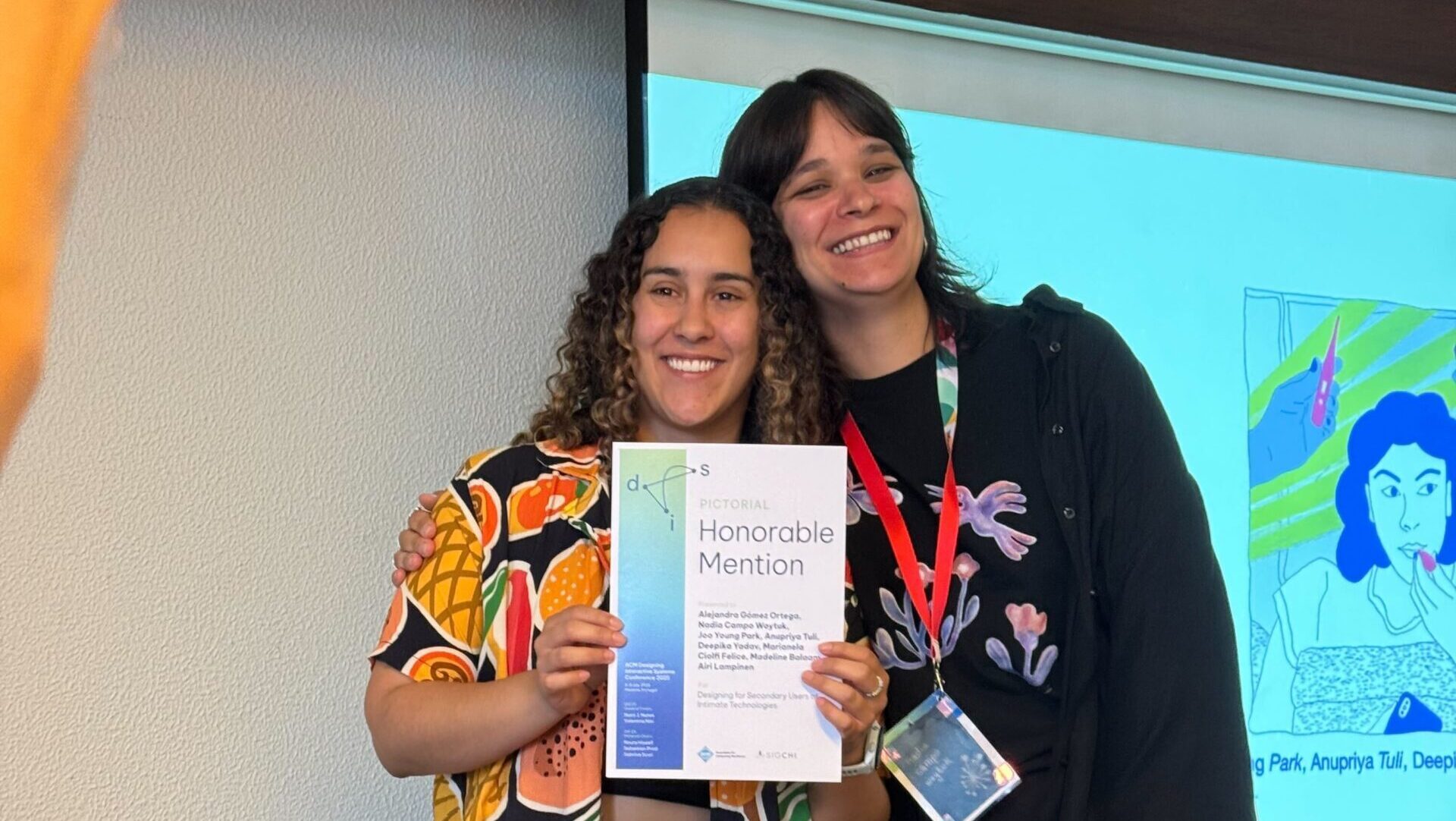
A team of researchers, including Digital Futures postdoctoral researcher Alejandra Gómez Ortega, received an Honorable Mention Award at the ACM Designing Interactive Systems (DIS) Conference 2025, held in Portugal this July. The award recognizes the paper “Designing for Secondary Users of Intimate Technologies”, co-authored by Alejandra Gómez Ortega, Joo Young Park, Deepika Yadav, Madeline Balaam, Nadia Campo Woytuk, Anupriya Tuli, Marianela Ciolfi Felice, and Airi Lampinen.
The work builds on research led by Airi Lampinen together with Madeline Balaam, focusing on shared uses of intimate technologies, with a particular emphasis on digital contraception.
The paper examines how digital contraceptives, such as Natural Cycles, involve not only the primary user — typically the person who can become pregnant — but also their partners as secondary users. While such technologies rely on basal body temperature data to predict ovulation and calculate fertility windows, they are often designed with only the primary user in mind.
The recognition at DIS 2025 underscores the significance of research at the intersection of intimate technologies, design, and shared digital practices, and celebrates the contributions of the full author team.
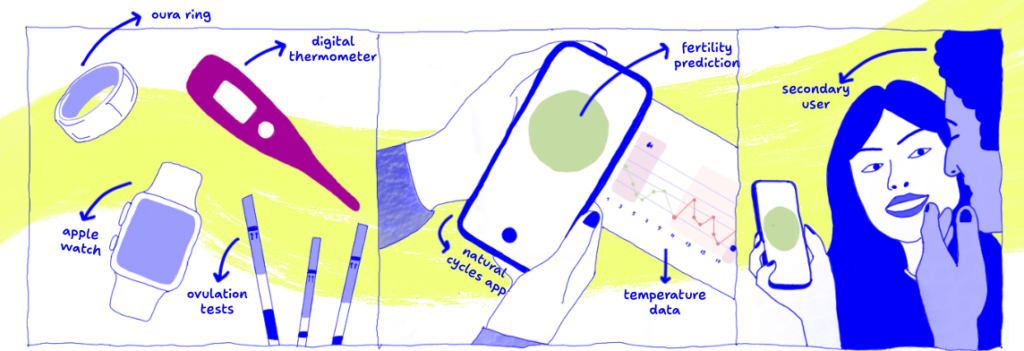
Through empirical investigation, the authors provide insights into how secondary users are envisioned and involved, and they outline three design directions for more inclusive approaches. The work also reflects on the complexity of designing for partners, who may be both collaborators and adversaries.
We spoke with Alejandra Gómez Ortega, Digital Futures postdoctoral researcher and first author of the paper, about the award, the research process, and the team’s collaboration.
Congratulations on the Honorable Mention at DIS! What does this recognition mean to you and the research team?
– This type of recognition from our research community is exciting! For me, it is especially meaningful given that the research is situated in an emerging and sensitive research context, and this pictorial marked the beginning of my Digital Futures postdoctoral fellowship. It was also deeply rewarding for the broader team, including PhDs, postdocs, and faculty at Stockholm University and KTH, who have been working on this large-scale study for several years.
Your paper looks at secondary users of digital contraceptives. What inspired you and the team to turn attention to partners rather than only the primary users of these technologies?
– Contraception is a relational practice: it always involves more than one person. However, we often see contraception as a practice that concerns only one person, and all the labor and responsibility fall on that person. For example, the birth control pill, one person takes it and typically manages their intake on their own. Digital contraception could promote the shared and relational aspects of contraception, but there are so many factors in place that it is fundamental to interrogate who secondary users of these technologies could be, how they are currently imagined to be, and how we could design for them.
Collaboration was key in this project, with co-authors from several institutions. How did the team work together to shape the research?
– Some of us have been working together on this topic since as early as 2020. It has been a very exciting collaboration initiated by Madeline Balaam and Airi Lampinen, initially funded by a Digital Futures Research Pairs grant. The research that our award-winning pictorial is a part of builds on a genuine, long-term, cross-institutional team effort.
The paper proposes three design directions for involving secondary users. Which of these directions do you see as most urgent or promising for future work?
– We discuss in the paper how designing for secondary users of intimate technologies ought to acknowledge their potential as co-users, who are helpful and co-responsible for contraception, but also adversaries, who are harmful or abusive. One of the most urgent considerations when balancing these contrasting roles is consent when accessing intimate digital contraception data. How can we dynamically manage consent? It is not something technology could ever solve once and for all, but we believe interaction design can play a meaningful role in encouraging more consentful practices.
Looking ahead, how do you hope this research will influence the design of intimate technologies and the conversations around digital contraception?
– We hope this research invites designers and researchers to continue to interrogate who is and should be considered a user of intimate technologies and how to design for the tensions that different types of users and the relationships between them raise. We also hope our research can offer points of reflection to those already using or considering to use digital contraception technologies.
Photo: Alejandra Gómez Ortega, Digital Futures postdoctoral researcher together with Nadia Campo Woytuk, PhD candidate at KTH and a co-author.