

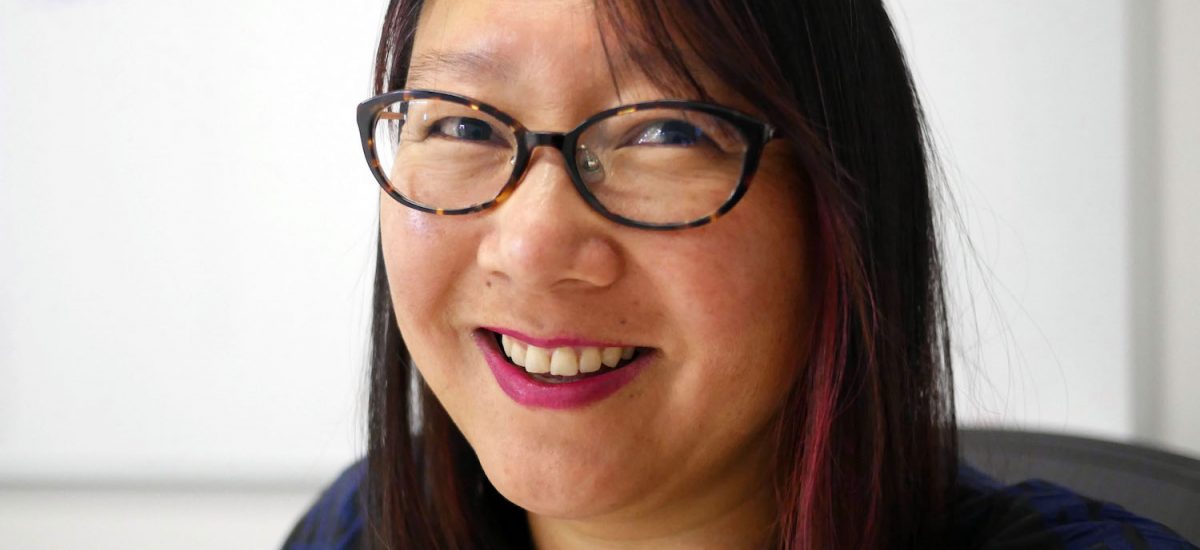
Wendy Ju spent June–December 2024 in Stockholm as a Digital Futures Scholar in Residence, hosted by Professor Barry Brown at Stockholm University. An Associate Professor at Cornell Tech, she specializes in designing intuitive human-robot and human-vehicle interactions. Wendy’s innovative methods and collaborations with global industry leaders aim to make technology more seamless and user-friendly.
Hi Wendy, in June you came to Stockholm as a Digital Futures Scholar in Residence. How did you find out about this opportunity, and what made you decide to come?
– I have been collaborating with Barry Brown on research about people’s interactions with robots in public places. I mentioned to Barry that I was interested in visiting Sweden for my sabbatical, and he suggested the Digital Futures Scholar in Residence Program.
Your research spans automated vehicle interfaces and human-robot interaction. Could you share what initially drew you to these fields and why they remain so important today?
– The common thread in my research interests is interaction—the reciprocal exchange of behavior between people or other actors and agents. I have always enjoyed building machines, and I love watching how everyday people interact in public. What is so interesting to me is how people bring their knowledge and experiences of interacting with other people or with animals to their interactions with things like autonomous cars or robots. I hope my research can help designers of cars and robots take into account how people behave and how they interpret the behavior of these new machine systems.
Collaboration is a key part of your work. What has it been like working with researchers at KTH, Stockholm University, and Linköping University? Have there been any particular projects or insights that have stood out during your time in Sweden?
– Cross-cultural collaboration is a particularly important aspect of my research because we all have blind spots, especially when observing our own culture. Having researchers with different backgrounds but common interests can help us better unpack what is transpiring in day-to-day interactions. What I have really enjoyed in my collaborations with Swedish counterparts is the wide array of approaches and philosophies being brought to bear on the question of designing interactions. There is something very democratic in both the Nordic approach to ethnography and the Scandinavian design ethos, which I am enjoying a great deal.
You’ve worked with industrial giants like Toyota, Spotify, and Volvo. How does your experience collaborating with industry inform your academic research, particularly in early-stage prototyping of automated systems?
– To differing degrees, most industries engage with people, but usually late in the design cycle. They conduct usability testing to ensure the products they design can be operated and safety testing to ensure their products don’t harm people. Very often, early-stage human research is done by marketing to find out what people want or to understand them better. Early-stage prototyping – the idea that you can create a cheap puppet or facsimile of what you are designing and find out how people respond to it before you’ve made anything – is somewhat radical. But it works: it affordably provides insights into what should be built early enough in the product development cycle to yield things that work better, function more safely, and better accommodate people. I find varying degrees of excitement and resistance to this approach, even within the same companies, but over time I think more and more companies are coming around to it.
What have you done in Stockholm so far? Are there any places in Sweden you’re hoping to visit before your residency ends in December?
– I got to enjoy Midsummer at Skansen, visit the Viking Museum, and go boating through the archipelago. I think the things I like best, though, are terribly mundane: riding the subway, watching people enjoying the parks, or seeing how people buy groceries. I feel like I’ve only scratched the surface of everything I’d like to know about Sweden, and already I’m plotting how to return.
Text: Johanna Gavefalk


