

About the project
Objective
Kidney diseases affects approximately 10% of the world’s population and is projected to become one of highest cause of life-lost-years within two decades. Despite this growing healthcare threat, diagnostic methods remain insufficiently precise, which unfortunately hinders early quantitative kidney disease staging. We aim to demonstrate a precision medicine pipeline that combines high-resolution optical 3D whole biopsy imaging with advanced AI-assisted 3D image analysis. Our approach eliminates preparation-induced biases by not slicing tissue biopsies, thereby preserving native 3D architecture and in-context spatial relationships. High-resolution imaging in 3D will spatially resolve key structural and molecular disease markers across scales in optically cleared biopsies. Moreover, our pipeline will automate 3D disease staging using AI-based image analysis, employing cutting-edge self-supervised learning to extract, segment, and quantify disease-relevant features objectively.
Background
Pathology impacts all aspects of patient’s care from identifying a disease, to monitoring its progression and to make crucial treatment decisions. Clinical kidney pathology thus plays a central role as method for diagnostic support in healthcare to help renal physicians and patients. Present nanoscale kidney pathology analysis is done in ultra-thin biopsies by electron microscopy, losing precious in-context 3D information of morphological and molecular pathophysiology. Moreover, used workflows are highly labor intense across sample preparation, imaging and imaging analyzing steps.
Cross-disciplinary collaboration
Imaging and image analysis are inherent pathology tools that can deliver diagnostic support and guide patient care. Our developed kidney pathology workflow will be faster, more precise, save healthcare labor costs, and be less biased with automate AI analysis support. The exploration of self-supervised methods for functional structure analysis is furthermore a rapidly growing and impactful area in AI, as researchers seek more sophisticated ways to analyze high-dimensional biological data without manual annotations. Our work positions KTH at the forefront of this cutting-edge field, meeting the rising demand for robust, scalable AI tools that can improve diagnostic accuracy and consistency.
PI: Hans Blom, Applied Physics/SCI/KTH
Co-PI: Gisele Miranda, Computer Science/EECS/KTH
About the project
Objective
- Development of novel interaction techniques that enable users to collaboratively create and modify immersive environments in real time, leveraging generative AI for dynamic content generation based on user input.
- Creation of AI-enhanced XR scenarios that vary in visual fidelity, input modalities, and agent embodiment. These will be systematically evaluated to understand their effects on user engagement, interaction quality, and perceived agency of AI.
- In-depth studies on how users perceive, interact with, and respond to AI agents in XR, with attention to trust, collaboration, and perceived autonomy in task performance and social interaction.
- Evidence-based design guidelines for integrating agentic AI in immersive environments, with considerations for interaction design, ethical implications, and support for individual and collaborative experiences.
This project is primarily situated at the intersection of Rich and Healthy Life and Cooperate within the Digital Futures research matrix. It explores how AI-enhanced XR environments can foster meaningful human-AI collaboration across immersive scenarios. The project also contributes to the societal context by designing XR experiences that support personal development, creativity, and skill-building. Through dynamic, interactive, and adaptive environments, the system enables users to engage in: (1) self-paced learning and creative prototyping, (2) scenario rehearsal and training, and (3) immersive co-creation. Central to the Cooperate theme is the exploration of multi-agent and multi-user interaction, focusing on how AI agents can support, guide, or adapt in real time to facilitate shared decision-making and effective human-human collaboration, mediated or enhanced by AI.
Background
Artificial Intelligence (AI) and Extended Reality (XR), which includes Augmented Reality (AR), Virtual Reality (VR), and Mixed Reality (MR), represent two rapidly evolving domains that are reshaping the modalities through which humans engage with digital systems. AI technologies are now deeply embedded in a wide array of applications, ranging from algorithmic recommendation systems and automated content generation to complex decision-support tools used in domains such as traffic management and surgical procedures. Concurrently, XR technologies are becoming increasingly mainstream due to advances in hardware and the availability of affordable head-mounted displays, making immersive experiences more accessible to both industry and the general public. Although both AI and XR are subjects of extensive research, the intersection of these fields, particularly within the context of Human-Computer Interaction (HCI), remains relatively under-investigated. In particular, the integration of AI-driven agents, including conversational agents, within XR environments poses novel questions regarding interaction design, user experience, and the role of intelligent systems as co-actors in immersive settings.
Cross-disciplinary collaboration
The researchers in the team represent the KTH School of Electrical Engineering and Computer Science and RISE Research Institutes of Sweden, Digital Systems Division.
About the project
Objective
This research aims to create a strong framework for Online Continual Learning (OCL) that will help AI models learn gradually from streaming data. It will tackle the catastrophic forgetting phenomenon and maintain long-term flexibility, with a focus on high-stakes, changing environments where models need to adjust quickly without retraining. This is especially important in healthcare and other real-world areas where data changes constantly and unpredictably.
Background
Traditional AI models, especially in Deep Learning (DL), are usually trained on fixed datasets and used as set systems, making them fragile in changing situations. When new tasks or data come up, these models either need expensive retraining or risk forgetting what they previously learned. This inflexibility limits their growth and usefulness in real-world scenarios
Online continual learning changes this by allowing models to update continuously as new data comes in, much like how humans learn over time. However, this approach brings complex challenges, such as finding a balance between stability (keeping old knowledge) and plasticity (adjusting to new information).
Finding this balance in high-dimensional areas is particularly hard, as updates need to happen in real-time while following strict memory and processing limits. Take healthcare as an example: patient profiles and medical knowledge change every day. AI systems must keep up without sacrificing safety or accuracy. The implications go beyond healthcare. They also include autonomous systems that must navigate changing environments and adaptive vision models that need to stay relevant amid ever-changing data streams.
About the Digital Futures Postdoc Fellow
Romeo Lanzino is a researcher in Artificial Intelligence. He focuses on Computer Vision, Continual Learning, and , bioinformatics . He is currently a postdoctoral researcher at KTH Royal Institute of Technology, where he’s researching adaptive AI systems that can learn continuously from changing data streams. He earned a PhD in Artificial Intelligence at Sapienza University of Rome (Italy) under the Italian National PhD AI program. His doctoral research looked closely at how Deep Learning is used for analyzing physiological signals, questioning common beliefs about how well neural networks perform in Electroencephalography studies. He has a background in computer science from Sapienza, where he received both his BSc and MSc with honors. Romeo is active in the academic community as a reviewer for top venues like ICCV, NeurIPS, and IEEE Transactions on Multimedia, and he also co-organizes related workshops at major conferences.
Main supervisor
Atsuko Maki, KTH
Co-supervisor
Josephine Sullivan, KTH
About the project
Objective
This project aims to build mathematical foundations and design efficient algorithms for problems on metric graphs. The research will proceed in two stages. First, the focus will be on developing geometric and topological methods to construct or reconstruct metric graphs from real-world data. Second, the project will address the extraction of statistical information and the solution of applied problems on metric graphs through optimization-based approaches.
Background
Metric graphs offer a powerful way to model real-world data that has an underlying network structure together with spatial attributes. Examples of metric graphs include road networks, brain connectivity networks, and social networks. Unlike tabular data which is well-structured, metric graphs are inherently complex and nonlinear. Existing methods are ill-suited for computational and practical analysis of metric graphs, which limits their utility as models for real data. My research aims to provide an essential framework for applications of metric graphs in machine learning and data science.
About the Digital Futures Postdoc Fellow
Yueqi Cao completed his PhD in mathematics at Imperial College London in 2025. He works on applied and computational mathematics and statistics, with a particular interest in geometric and topological data analysis. Prior to that, he obtained master’s degree and bachelor’s degree in mathematics from Beijing Institute of Technology.
Main supervisor
Johan Karlsson
Co-supervisor
Sandra Di Rocco
About the project
Objective
This project aims to create a real-time digital twin framework enhanced with physics-informed neural networks (PINNs) to guide the development of plant-based meat analogs. By integrating mechanistic modeling with AI, the framework will provide deeper insight into protein structuring and deliver accurate, efficient tools for predicting and optimizing texture.
Background
Food production is a major driver of climate change, biodiversity loss, and public health challenges. While the transition to plant-based diets offers clear sustainability benefits, consumer acceptance is limited by the difficulty of reproducing the texture of meat. Current development approaches rely on costly, time-consuming trial-and-error experimentation. This project pioneers a systematic, data- and physics-driven strategy to accelerate texture design, reduce development costs, and enable more sustainable, nutritious, and appealing plant-based foods.
About the Digital Futures Postdoc Fellow
Jingnan Zhang holds a PhD in Food and Nutrition Science. Her research integrates computational modeling and soft matter physics with food science, enabling a systems-oriented approach to connect digital technologies with sustainable and resilient innovations for the future of food.
Main supervisor
Francisco Javier Vilaplana Domingo, Professor, Department of Chemistry, KTH Royal Institute of Technology.
Co-supervisor
Anna Hanner, Associate professor, Department of Fibre and Polymer Technology, KTH Royal Institute of Technology.
About the project
Objective
There are abundant unlabeled and noisy data in research fields of modern biology and medical science. Naturally, estimating biological structures and networks from unlabeled and noisy data widens the scope of future AI-based research in biology, with directly actionable effects in medical science. The major technical challenge is development of robust AI and GenAI methods that can use information hidden in unlabeled and noisy data. A promising path to address the challenge is to include a-priori biological knowledge in developing models for signals and systems, and collecting data, and then regularize the learning of AI methods.
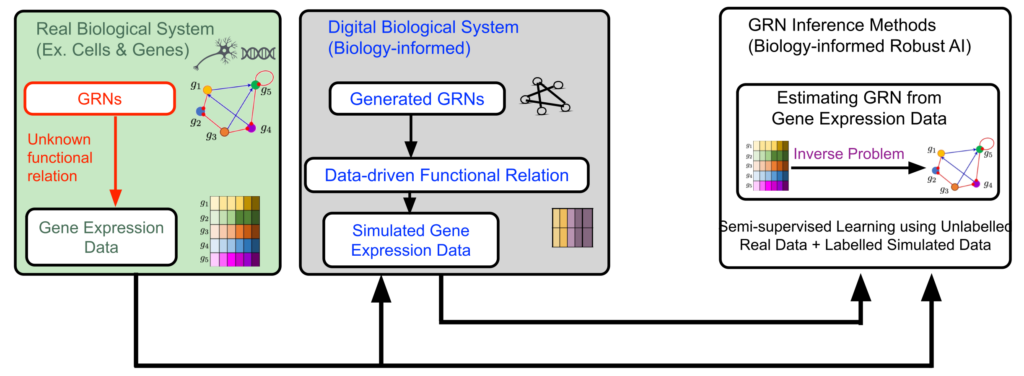
In pursuit of addressing the challenge, we focus on inference of gene regulatory networks (GRNs) from their noisy gene expression level data – a challenging inverse problem in biology. Understanding and knowing a GRN is a key for understanding biological mechanisms causing diseases such as cancer. While gene expression data is available in abundance, the data is unlabeled due to absence of knowing the true GRNs underneath. In addition, the expression data is noisy. So far, use of AI for robust estimation of large-size GRNs from unlabeled and noisy gene expression level data has been little exercised. Indeed, learning from unlabeled and noise data is challenging for AI methods. Here comes the motivation for the proposed project – Biology-informed Robust AI (BRAI). The objective of the BRAI project is to develop fundamental theory and tools for inferring complex biological structures and networks from unlabeled and noisy data using a-priori biological knowledge, focusing on the challenging inverse problem ‘GRN inference’.
Background
The human reference genome contains somewhere between 19,000 – 20,000 protein-coding genes. For human cells (ex. cancer cells), GRNs are large. In reality, the GRNs are not observed directly. They are observed through the gene expression data. Therefore, it is difficult to collect labeled data as pairwise GRN- and -expression data for training AI and machine learning (ML) in a standard supervised learning approach. On the other hand, there are gene expression data available in abundance as unlabeled data, without the true GRNs underneath.
The actual functional relationship between a GRN matrix and its expression data is governed by complex biophysics. For complex biological systems like cancer cells, the true functional relationship governing GRN-to- expression data is unknown, and difficult to model. In addition, the gene expression data is noisy, as the expression data contains not only information from the hidden GRN, but other known-and-unknown biological events.
Naturally, the GRN inference problem – estimating a large GRN from its noisy gene expression data without having labeled data and knowing their actual functional relationship – is a challenging inverse problem.
Cross-disciplinary collaboration
The project will combine methods and techniques from separate research fields – (a) biological knowledge about GRNs from bioinformatics and system biology, (b) graph theory and topological data analysis for network modeling from mathematics, and (c) robust machine learning (ML) and GenAI from AI / ML.
About the project
Objective
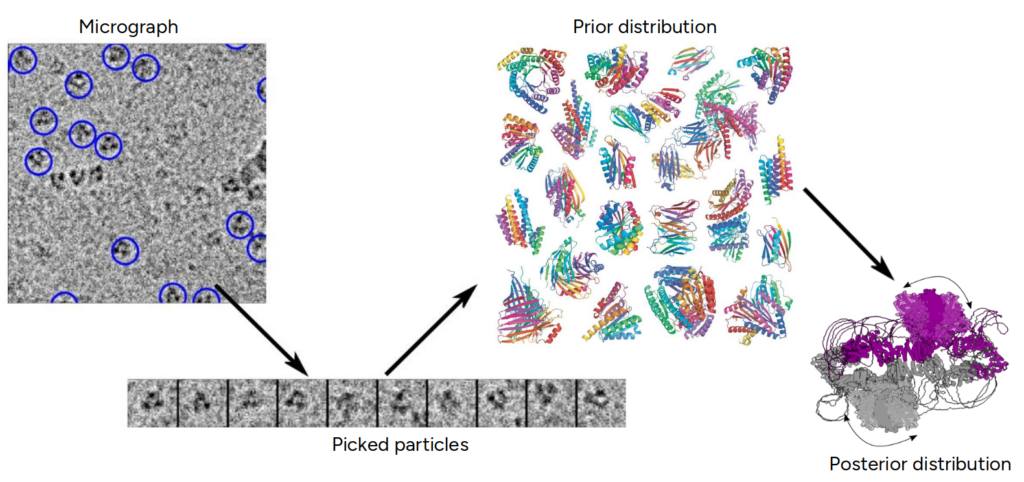
This project aims to advance the understanding of flexible protein dynamics by developing novel algorithms that integrate cryo-electron microscopy (cryo-EM) data with computational predictions using generative AI and statistical modeling. The goal is to overcome current limitations in protein structure prediction by accurately reconstructing continuous, atomic-resolution 3D structures and their dynamic variations. Ultimately, the project will provide transformative tools for the global life sciences community, enhancing insights into molecular functions critical for health, biotechnology, and medicine while strengthening Sweden’s leadership in AI4Science.
Background
Understanding the dynamic structures of flexible proteins is a major challenge in structural biology, as these molecules undergo continuous conformational changes essential for their biological functions. While cryo-electron microscopy (cryo-EM) has revolutionized the visualization of biomolecules at near-atomic resolution, capturing their full dynamic range remains difficult. Current computational methods, including AI-based predictions like AlphaFold, often fall short in modeling the continuous motions and heterogeneity of flexible proteins.
This project builds on advances in cryo-EM imaging, statistical modeling, and generative AI to develop new approaches that can more accurately reconstruct and analyze protein dynamics, addressing critical gaps in both experimental and computational techniques.
Cross-disciplinary collaboration
The project brings together experts from mathematics, machine learning, and structural biology to tackle complex challenges in biomolecular dynamics. Mathematicians contribute advanced statistical and inverse problem-solving techniques crucial for developing robust reconstruction algorithms. Machine learning specialists develop generative AI models to create data-driven priors that enhance the interpretation of cryo-EM data.
Finally, structural biologists provide essential expertise in cryo-EM methodologies, including sample preparation and image processing, ensuring high-quality experimental data, but more importantly provide critical domain expertise in order to design and evaluate the proposed methods.