

Background and summary of fellowship
Soma design puts first-person aesthetic sensory experience and expertise in the front seat during the design process. It builds on the theories of somaesthetics – a combination of soma—our subjective self, body, emotion, and thinking—and aesthetics—our perceptual appreciation of the world. Through engaging with and deepening your capacity to discern sensuous experiences, you can examine and improve on connections between sensation, feeling, emotion, and subjective understanding and values. Soma design is a path to imagine – through your senses, movements and material encounters – what could be during a design process. A soma design process thrives off the aesthetic potential of the sociodigital materials and the creative process of shaping these into dynamic gestalts, orchestrated experiences.
Here, Höök is exploring two strands of work:
First, digital touch: exploring the aesthetic potential of bodyworn digital/physical materials to evoke and feel touch. It is an interdisciplinary project combining competencies: in body-worn soft and compliant sensor nodes; high-pressure microfluidics and miniaturized actuators; and their materials science; backscatter sensor-actuator network technology; and interaction design addressing touch through intimate correspondence relationships through soma design.
Second, ethics: the goal is to contribute new knowledge to the field of design in the form of an analytical, practical and pragmatic framework to grasp the ethicality of emerging, complex, felt, bodily practices that shape our corporealities and through which ethics are enacted – manifested and cultivated through our moving bodies.
Background and summary of fellowship
In many application areas, it is not sufficient to present the output of machine learning models to the users without providing any information on what leads to the specific predictions or recommendations and how (un)certain they are. The strongest machine learning models are however often essentially black boxes. In order to enable trust in such models, techniques for explaining the predictions in the form of interpretable approximations are currently being investigated. Another cornerstone for enabling trust is that the uncertainty of the output of the machine learning models is properly quantified, e.g., that the output prediction intervals or probability distributions are well-calibrated.
Motivated by collaborations with Karolinska Institutet/University hospital on sepsis prediction, Scania on predictive maintenance and the Swedish National Financial Management Authority on gross domestic product (GDP) forecasting, techniques for quantifying uncertainty and explaining predictions will be developed and evaluated. In addition to scientific papers, the output of the project will be Python packages to support reliable machine learning, enabling predictions of state-of-the-art machine learning models to be complemented with explanations and uncertainty quantification.
Background and summary of fellowship
Social robots and virtual agents are currently being explored and developed for applications in a number of fields such as education, service, retail, health, elderly care, simulation and training and entertainment. For these systems to be accepted and successful, not only in task-based interaction but also to maintain user engagement, in the long run, it is important that they can exhibit varied and meaningful non-verbal behaviours, and also possess the ability to adapt to the interlocutor in different ways. Adaptivity in face-to-face interaction (sometimes called mimicry) has for example been shown to increase liking and affiliation.
This work addresses how style aspects in non-verbal interaction can be controlled, varied and adapted, across several modalities including speech, gesture and facial expression. The project entails novel data collection of verbal and non-verbal behaviours (audio, video, gaze tracking and motion capture) with rich style variation, but also makes use of existing datasets for base training. Synthesis models trained on this data will be based primarily on deep probabilistic generative modelling, conditioned with relevant style-related parameters. Multimodal generation paradigms, that produce congruent behaviours in more than one modality at a time, e.g. both speech and gesture, in a coherent style, will also be explored and evaluated in perceptual studies or experiments with real interactive contexts.
About the project
Objective
We propose to build a physical prototype of a modular lower-limb exoskeleton system with a digital interface to a real-time variable controller. The prototype will be equipped with motors that provide variable control to different joints and joint ranges of motion while supporting real-time control of its kinetic properties. By varying the assistive strategies in the exoskeleton system via a digital interface, we will enable human-in-the-loop (HILO) optimization to find optimal control strategies for different users and goals.
Background
Persons with physical disabilities are the largest minority group in the world, and global trends in ageing populations indicate an expected increase in the population affected by disability. In Sweden, musculoskeletal disorders are one of the most common causes of long-term disability.
Wearable robotic assistive exoskeletons have rapidly developed in the past decades, yet only a handful of products are used frequently, either within or outside research environments. A major reason is that a device must be adjusted for user compliance and efficacy for optimal effect and comfort. Using methods for automatically discovering, customizing, and continuously adapting assistance could overcome these challenges, allowing exoskeletons and prostheses to achieve their potential.
Crossdisciplinary collaboration
The researchers in the team represent the KTH School of Engineering Science, Department of Engineering Mechanics and KTH School of Industrial engineering and management, department of Machine Design.
About the project
Objective
The objective of the Improving air quality and Health risk forecasts by data-driven modelling of traffic and atmospheric environment (iHorse) project is to increase the accuracy of air pollution and health risk forecasts. The current system relies on deterministic meteorological dispersion modelling to forecast the impacts of emissions on concentrations. One of the main uncertainties is forecasting emissions from road traffic which is a dominant source of air pollution in the urban environment. In this project, emissions are calculated based on detailed information on the vehicle fleet composition and emission factors. In addition, a novel, innovative data-driven deep learning model will be developed and integrated with the air pollution and traffic modelling processes. The aim is to improve the forecast of air pollutants, pollen and AQHI for the Greater Stockholm area.
Background
Air pollution is one of the leading causes of mortality worldwide. Acute effects of air pollution are due to short-term exposures that can lead to reduced lung function, respiratory infections and aggravated asthma. Public information regarding the expected health risks associated with current or forecasted concentrations of pollutants and pollen can be very useful for sensitive persons when planning their outdoor activities. Predicting traffic emissions and induced air pollution has been an activity of high priority in the agenda of transport authorities and municipalities The project will also contribute to the use of artificial intelligence, identified as a key priority of the city of Stockholm and the SMart URBan Solutions (SMURBS; http://smurbs.eu/), an EU project involving several European cities with the overall aim to provide solutions based on Earth Observations that make cities more smart and sustainable.
Crossdisciplinary collaboration
The researchers in the team represent the Department of Environmental Science, SU and the School of industrial engineering and management, KTH.
Publications
We like to inspire and share interesting knowledge!
Preprint is currently under review for the journal Atmospheric Chemistry and Physics (ACP):
- Improving 3-day deterministic air pollution forecasts using machine learning algorithms. Received: 31 Jan 2023 – Discussion started: 08 Feb 2023Christer Johansson (1,2), Zhiguo Zhang (3), Magnuz Engardt (2), Massimo Stafoggia (4), and Xiaoliang Ma (3)
- Department of Environmental Science, Stockholm University, Stockholm, Sweden
- Environment and health administration, SLB-analys, Stockholm, Sweden
- KTH Royal Institute of Technology, Dept. of Civil and Architectural Engineering, Stockholm, Sweden
- Department of Epidemiology, Lazio Region Health Service, Rome, Italy
DOWNLOAD APP! Link to the mobile phone App with air quality and health risk forecasts for Stockholm (in Swedish only).
Ladda ner appen för Android
Ladda ner appen för iOS/Iphone
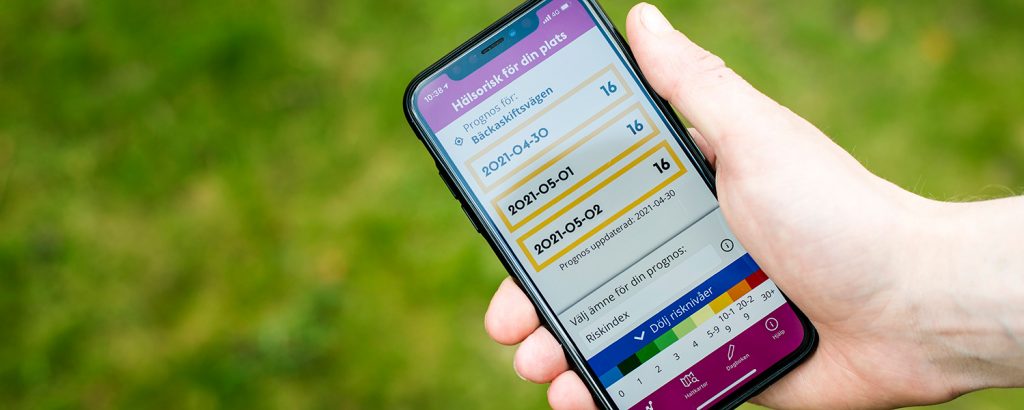
Photo: Johan Pontén
About the project
Objective
This project aims to develop hardware and software for an open-source DNA test to enable point-of-care self-testing. This system will consist of a disposable and low-cost test strip, a low cost, and a small electronic device that carries out the tests. It will read the results digitally and communicate them directly to smartphones. The project will be carried out in a collaboration between a research lab at CBH School, the KTH prototype centre and hospitals for patient samples and testing. In the short term, this project can immediately be used for digital DNA detection of the novel SARSCoV-2 virus. More importantly, open-source, fully digital DNA tests can have a long-term effect on global health care by digitalizing and democratizing molecular diagnostics.
Background
The classical Nucleic-acid amplification testing (NAAT) requires several steps, and the current tests are mainly performed by highly trained personnel using advanced machinery in centralized laboratories. In the past decade, the Hamedi Lab and numerous others pioneered the development of analytical devices fabricated by using high throughput printing techniques on paper and other substrates to build diagnostic devices which are very cheap and simple to manufacture. All steps of liquid handling, storage of reagents, biochemistry, and electroanalytical detection, can be performed inside this paper. A few examples have shown that NAAT tests can be performed using these printed diagnostics devices.
Crossdisciplinary collaboration
The researchers in the team represent the School of Engineering Sciences in Chemistry, Biotechnology & Health, KTH and the School of industrial engineering and management, RISE.
About the project
Objective
The main aim of this project is to increase the diagnostic power of PET images for detecting lung cancer lesions at an early stage by overcoming the loss of contrast and spatial resolution caused by respiratory motion during data acquisition. Traditional ways of tackling this problem are computationally too demanding to be useful in clinical practice. For this reason, we will implement algorithms deploying a mixture of modelling of the data-acquisition set-up and machine-learning-based tools for image registration. The challenges of this project consist mainly in tackling the size of this four-dimensional image reconstruction problem and in being able to deliver images to radiologists in a time frame compatible with the hospital workflow.
In collaboration with our clinical partners at Karolinska Hospital in Huddinge, we will collect gated PET line-of-response activity data and corresponding 3D CT attenuation maps of the thorax region of 400 patients and test and optimise our 4D algorithms and gating strategies on this data. We will evaluate the resulting reconstructions with a particular focus on their diagnostic power for small lung lesions and make the reconstruction software package openly available.
Background
PET (Positron Emission Tomography) is a medical imaging modality that reconstructs the 3D distribution of metabolic activity by detecting photons emitted during the in vivo annihilation of free electrons with positrons from an injected radioactive tracer. In principle, cancer lesions will be visible in the reconstructed image with high contrast compared to the surrounding healthy tissue thanks to their peculiar metabolic fingerprints (e.g. higher sugar metabolism). PET is, in fact, one of the most powerful imaging modalities for cancer diagnosis and staging. However, the long acquisition time required to collect projection data with an acceptable noise level leads to motion artefacts that strongly affect the contrast-to-noise-ratio of lesions. This is of particular interest when trying to detect tumours that are of a size comparable to the system resolution (~5 mm) and that are continuously moving because of respiratory motion. Those lesions are the most important ones to detect for early-stage diagnosis, leading to a better prognosis for the patient.
Crossdisciplinary collaboration
This is a project in which state-of-the-art mathematical research for solving large inverse problems meets the clinical practice of medical imaging and brings together faculty from the Department of Mathematics at the SCI school at KTH with faculty from the Department of Biomedical Imaging of the CBH school.