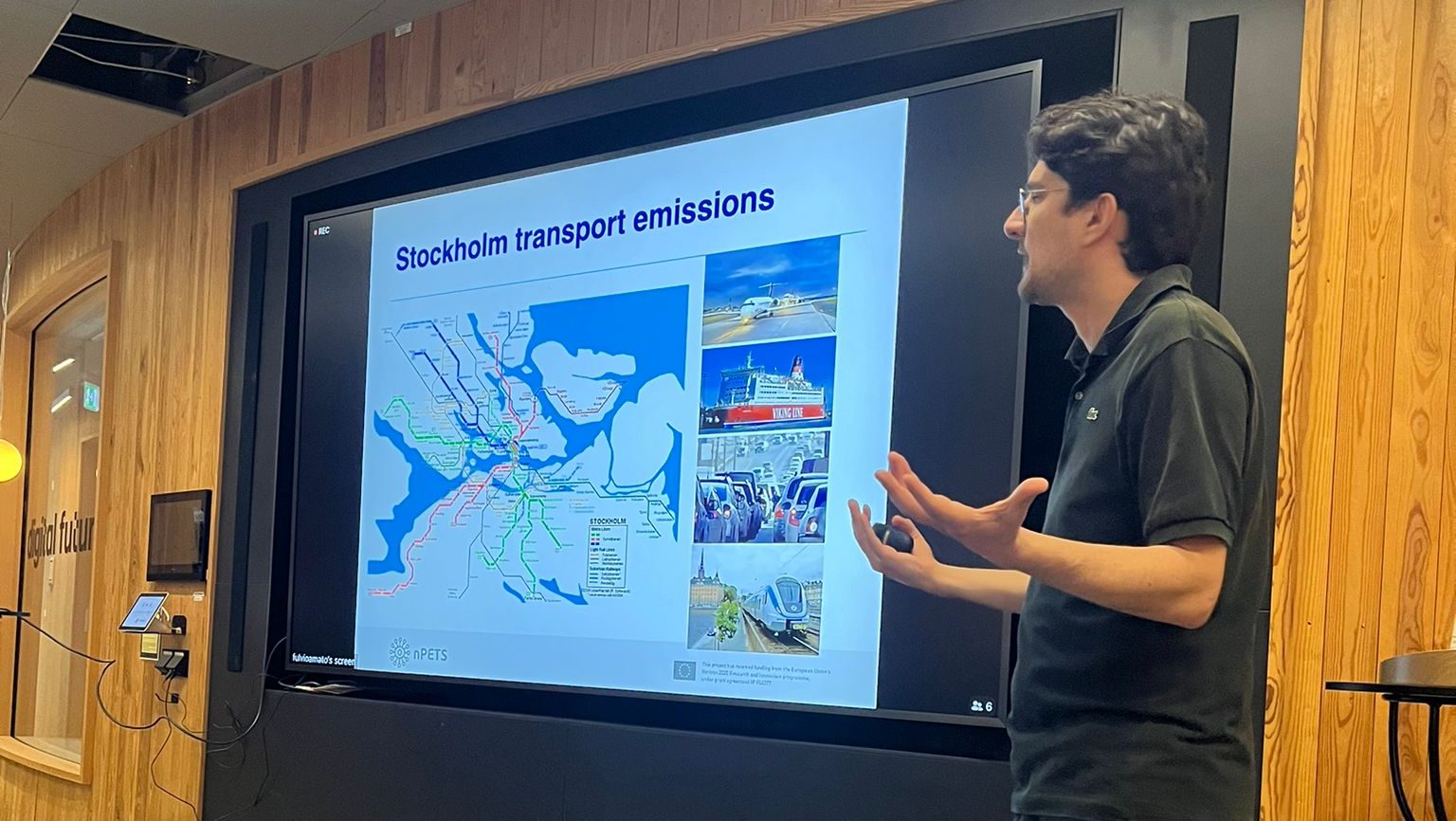
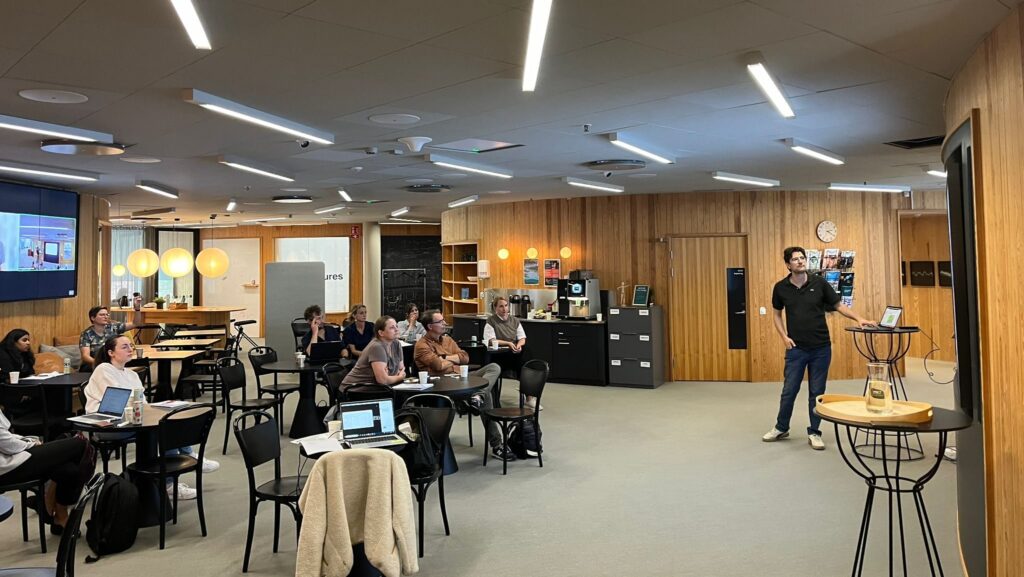
On August 22, Digital Futures hosted a seminar featuring Dr. Fulvio Amato, Senior Scientist at the Spanish National Research Council (CSIC) and a leading expert in atmospheric particle emissions. The event, titled “How can modelling and digital visualization tools be used to understand sources of atmospheric ultrafine particles?” was part of Dr Amato’s Scholar in Residence visit in Stockholm from July 12 to August 25, 2024. The visit was hosted by Ellen Bergseth, Associate Professor, Department of Machine Design at KTH and a member of the Digital Futures Faculty.
“During my stay at KTH, I found a very enthusiastic and stimulating research environment that promotes excellence through international collaboration. Sweden is a very well-educated country where citizens’ wellness and culture are a priority. Additionally, I particularly enjoyed the silent environment! In my opinion, research stays abroad are a powerful opportunity for scientists to pause the daily administrative duties and have time to focus on a single objective and reflect in depth on the future of their research,” says Fulvio Amato.
Dr. Amato, who holds a PhD in Natural Resources and Environment from the Polytechnic University of Catalonia, is an experienced researcher in measuring particle emissions at traffic sites, airports, and other urban environments using advanced instruments and sensors. During his stay in Stockholm under the Scholar-in-Residence (SIR) program, Dr. Amato collaborated with SLB Analys to better understand the sources contributing to ultrafine particle (UFP) concentrations in the city, focusing on particles smaller than 100 nm in diameter.

The seminar highlighted Dr. Amato’s approach to digital transformation in UFP research, focusing on two key aspects:
- Source contribution analysis using Positive Matrix Factorization (PMF): Leveraging data from the nPETS project, Dr. Amato applied PMF analysis to identify and estimate individual source contributions from various sources such as gasoline, diesel, aircraft, ships, and residential heating. This analysis was conducted using the EPA PMF tool, emphasizing the importance of physico-chemical characterization of UFPs for accurate source identification.
- Validation of AIRVIRO dispersion modelling and digital visualization system: The second phase of Dr. Amato’s work involved using the source contribution estimates to validate the AIRVIRO dispersion modelling system. AIRVIRO, a sophisticated digital tool, incorporates diverse transport characteristics, vehicle technologies, traffic conditions, and route choices to provide detailed data essential for health impact assessments. The system has been previously utilized in Stockholm for regulated air quality parameters such as PM and NOx, and now aims to extend this analysis to UFPs. AIRVIRO will also be used to simulate future scenarios, such as the impact of low-emission zones, enabling the assessment of long-term policy impacts on air quality.

Dr. Amato’s visit and seminar significantly advance our understanding of ultrafine particle pollution in urban environments. By combining advanced modelling techniques with digital visualization tools, his work aims to provide more precise and actionable data for policy-making and health impact assessments, ultimately contributing to a healthier urban atmosphere.
For more details on Dr. Amato’s research and ongoing projects, visit the nPETS project website.