About the project
Objective
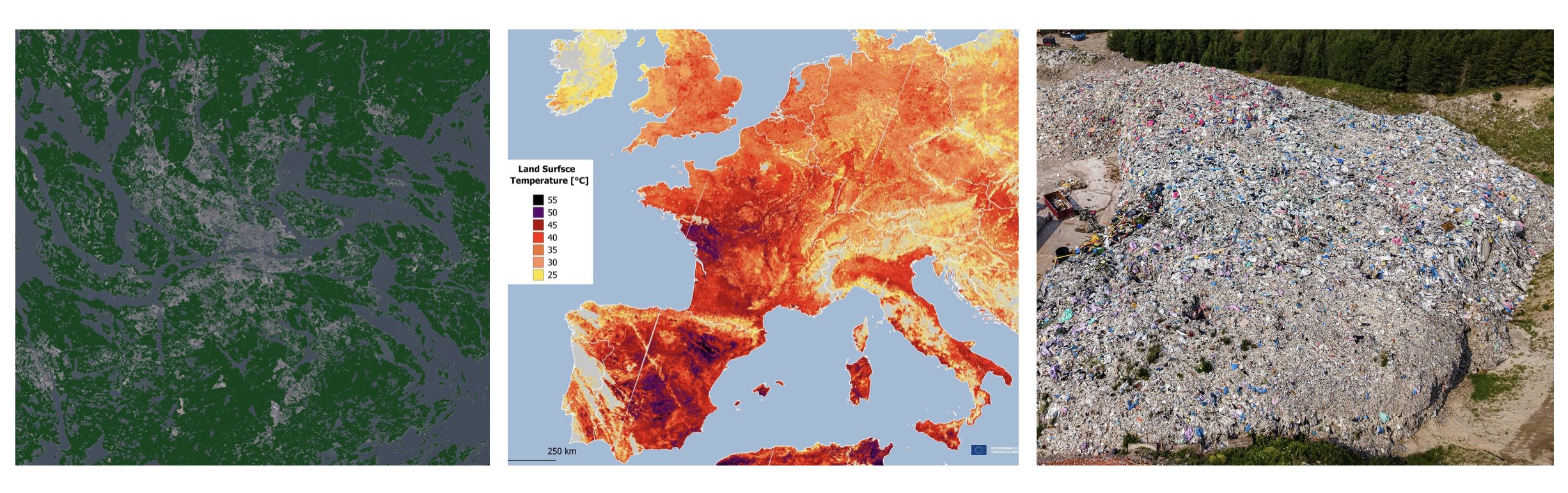
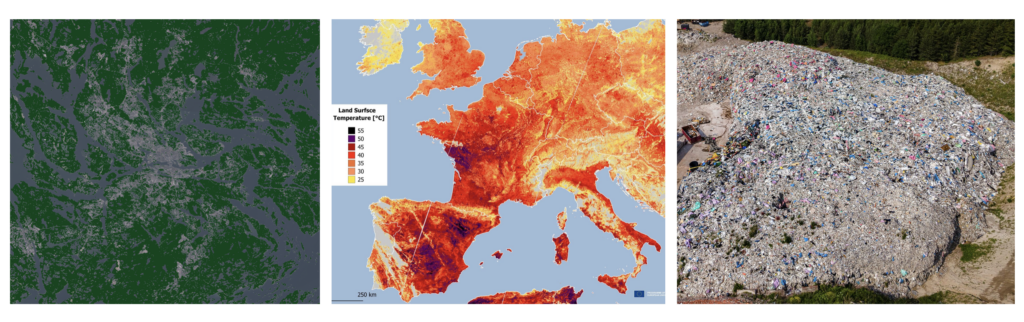
UrbanEI aims to advance AI-powered Earth Observation (EO) for urban environmental intelligence by mapping and monitoring urban green infrastructure (UGI), assessing urban heat hazards, and detecting illegal waste dumping and burning. The project will integrate satellite EO, environmental, and crowd-sourced data within geospatial foundation models and generative AI frameworks. EO foundation models will be adapted to process large-scale multimodal datasets, enabling detailed UGI mapping, heat-hazard detection, and improved urban heat-risk assessment.
Generative AI will be explored to produce super-resolution imagery for high-resolution UGI mapping and daily land surface temperature estimation, and to generate city-wide air-temperature surfaces from sparse crowd-sourced measurements. In parallel, UrbanEI will pioneer the use of generative AI and open EO data, including Sentinel-2 imagery, for early detection and monitoring of illegal waste dumping and burning.
Expected outcomes include dynamic high-resolution maps of urban green infrastructure, improved city-scale air-temperature and urban heat-island assessments, and earlier detection of illegal waste activities. UrbanEI will advance the state of the art in AI and EO for urban environmental intelligence and provide timely, reliable, and actionable information for climate adaptation, environmental monitoring, and sustainable urban development.
Background
With 2024 marking the warmest year on record and 2026 ranking as the second-warmest year to date, the accelerating impacts of climate change are increasingly evident. Intensifying heatwaves and extreme weather pose major challenges, particularly in rapidly growing cities where heat, environmental degradation, and illegal waste activities threaten public health, infrastructure, and sustainable development. There is an urgent need for timely, accurate, and actionable environmental intelligence to support urban monitoring, mitigation, and adaptation.
Cross-disciplinary collaboration
To be announced
PIs of the project
Yifang Ban, KTH
Josephine Sullivan, KTH
Sebastian Hafner, RISE