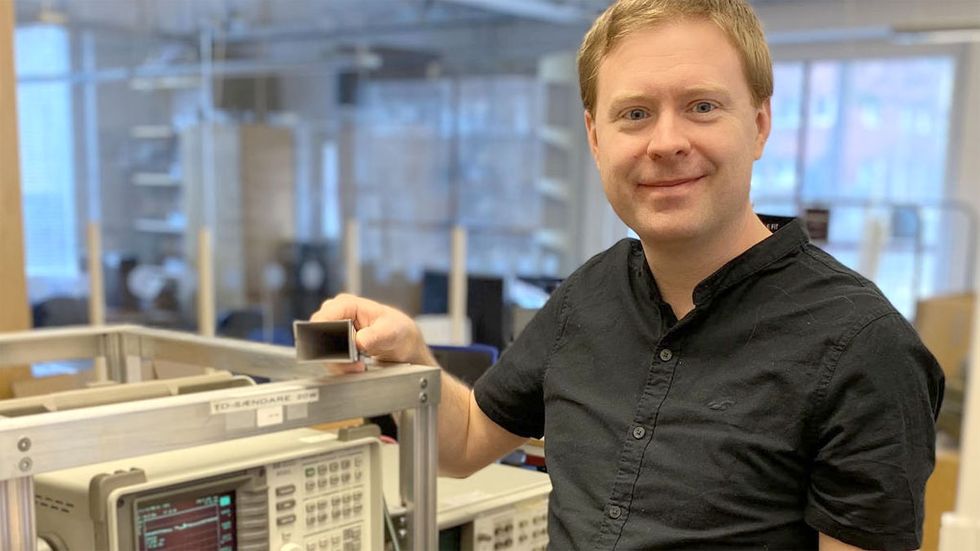
Emil Björnson is an Associate Professor at Linköping University since 2014 and became a part-time visiting full professor at the KTH Royal Institute of Technology in 2020.
Björnson was the first recipient of the Digital Futures Fellowship for strategic strategy recruitment and now he is an elevated IEEE (pronounced “Eye-triple-E”) Fellow 2022.
Emil, congratulations on being elevated to IEEE Fellow 2022 for contributions to multi-antenna and multi-cell wireless communications! For those that are not familiar with IEEE, explain shortly what this organization is all about?
– IEEE stands for the Institute of Electrical and Electronics Engineers. It is actually the world’s largest technical professional organization dedicated to advancing technology for the benefit of humanity. The members are engineers, scientists, and professionals such as computer scientists, software developers, information technology professionals, physicists, medical doctors, and many others.
IEEE is a not-for-profit organization – can you describe what you do?
– IEEE organizes the major conferences and most important scientific journals in my field of research, namely wireless communications and signal processing. The organization dates back more than 100 years and wireless communication pioneers such as Guglielmo Marconi, the Italian radio inventor, and Ernst Alexandersson, the KTH graduate who built the world heritage Grimeton Radio Station in Varberg, are previous members. I have been a member since I started my PhD studies in 2007 and nowadays I’m actively involved in several technical committees, I’m an associate editor for several journals, and I organized an IEEE-sponsored conference in September this year.
Can you explain why you got this recognition – elevated IEEE Fellow – and what impact this will have on what you do?
– The nomination letter mentioned two main reasons for elevating me to IEEE Fellow. Firstly, my research contributions to multi-antenna wireless communications, particularly a technology component called “Massive MIMO” that makes 5G networks more efficient than 4G. I have written three textbooks on this topic and my publications have received more than 16000 citations, which are indications of the impact that my research group has achieved. Secondly, I have been an early promoter of research reproducibility in my field of research, namely that we should share our research results, datasets, and simulation code with other researchers. I believe the research community can make swifter progress if we cooperate and help others to improve on our results.
I am only 38 years old, which is an unusually young age for getting this recognition. I hope the fellowship will support me in attracting research funding and top-level students and postdocs to the new research team that I’m forming at KTH Kista. Since I have already reached many career goals, I can now afford to do more high-risk research and work with the things that I believe the most in.
You are a regular faculty member at LiU, a guest professor at KTH and earlier this year you were the first recipient of the Digital Futures Fellowship for strategic strategy recruitment. You write books and articles, do research and co-host the podcast Wireless Future and has a popular YouTube channel with the same name – how do you find time and what drives you?
– I am very fortunate to have a job that is also partially like a hobby for me. For example, I like to make illustrations, take photos, and edit videos. The YouTube channel and video podcast allow me to combine my regular work duties with the things I like to do in my spare time. Especially under the pandemic, this has been a great way to interact with fellow researchers and students all around the world. What really drives me is to learn how to make future wireless communication systems more reliable and efficient, and then share my insights with other people.
Photo: Emma Axelsen