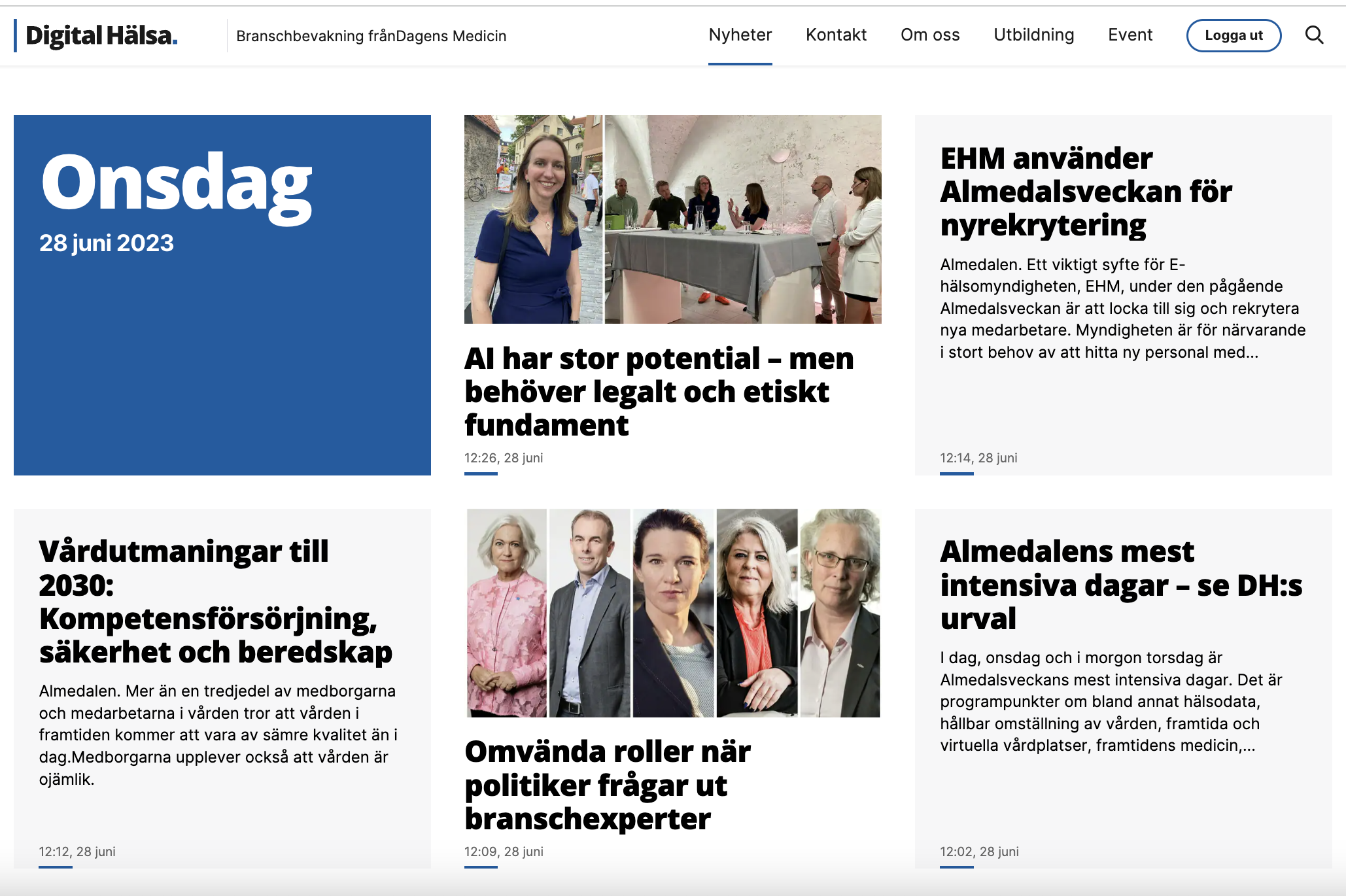
AI has great potential in everything from medicine to sustainability and transport. But for the technology to have an optimal effect and acceptance in society, it must be used in a responsible way based on a solid legal, ethical and moral foundation. This could be read in an article covering a panel discussion at Almedalen Week by Jonny Sågänger on the news service Digital Health.
Anna Kiefer, Chief Operating Officer at Digital Futures was one of the panellists together with Joakim Skog at Vinnova, Daniel Akenine at Microsoft, and Evelina Anttila at Wellstreet in a seminar arranged on 27 June by the consulting and audit firm PwC in connection with the Almedalen Week in June. The panel was moderated by Felix Wideroth and Fredrik Lundberg, both at PwC.
– AI has already had a real impact on society, not least thanks to the fact that the art of medicine and the art of engineering increasingly go hand in hand and, thanks to this, for example, develop diagnostic methods, said Anna Kiefer.
Joakim Skog, Strategic Area Lead Future Innovations at Vinnova, emphasized that – in addition to using AI’s achievements – it is also important for the innovation authority to investigate the consequences of various future scenarios. According to Daniel Akenine, National Technology Officer at Microsoft, many organizations have a thorough understanding of what they need to do to improve operations, but they do not have the insights required to understand how AI can be a tool for them to achieve this.
Both the panel and the seminar participants had a positive basic view, that AI can contribute in a positive way. A current survey “Svenska folket om AI” conducted by PwC with the support of Kantar Sifo shows that eight out of ten respondents in the Swedish population believe that AI can have a negative impact on society but that it is possible to increase the population’s trust in technology with the help robust security, increased regulation, education and knowledge,
At the turn of the year, EU citizens may already receive the world’s first unified AI legislation, the AI Act, which may be implemented within a couple of years, something Evelina Anttila from the venture capital company Wellstreet was very positive about.
Anna Kiefer further highlighted that regulation in research, development and innovation in the medical field is particularly important to create trust among the public and avoid intrusions into people’s personal integrity.
The seminar is available in its entirety on the video streaming service Almedalsveckan Play.
Photo: Jonny Sågänger