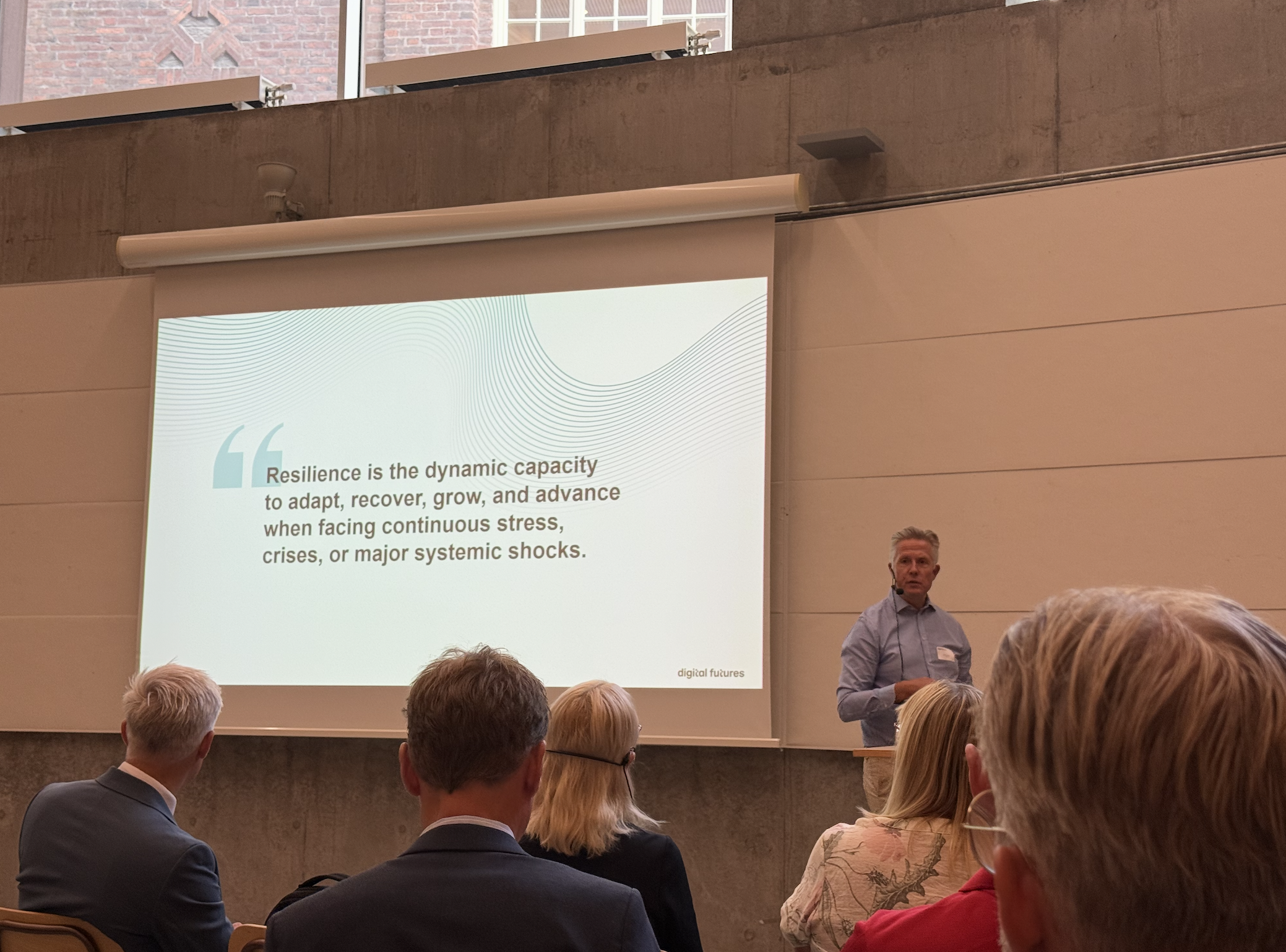
How can we build digital and physical systems that are better prepared for disruption? This question brought researchers, industry representatives and public-sector stakeholders together at the Digital Futures Resilience Workshop on 19 August.
As societies become increasingly dependent on interconnected digital and physical systems, resilience is becoming a critical challenge. Cyber threats, disinformation, information security risks, climate-related risks, vulnerabilities in critical infrastructure and rapidly changing technologies all highlight the need for systems that can not only withstand disruption, but also adapt and recover.
The Digital Futures Resilience Workshop brought together participants from academia, industry and the public sectorto explore these challenges from different perspectives. Around 80 participants took part in the workshop at the Digital Futures hub, representing a wide range of organisations and expertise.


The academic community was strongly represented, with participants from KTH, Stockholm University, Uppsala University, RISE, the Norwegian University of Life Sciences (NMBU), CNRS and universities and organisations in Morocco and Thailand. Industry participants included representatives from companies such as Xylem, Vattenfall, Ericsson, Hitachi Energy, Svenska kraftnät, TRATON, Plexigrid and Skanska. Public-sector organisations included Region Stockholm, the City of Stockholm and the National Cybersecurity Centre (NCSC).
The broad participation reflected the cross-sector nature of resilience challenges – and the importance of bringing different perspectives together to address them.
The half-day programme featured presentations from several research centres and a broad range of ongoing research projects. It opened with contributions from Digital Futures, NSCS, Cybercampus, the Centre for Cyber Defence and Information Security, and the KTH Center for Total Defence. This was followed by research presentations covering topics ranging from cyber threat modelling and resilient 6G systems to organisational resilience, resilient edge computing and the use of AI and digital twins for critical infrastructure.

Other presentations focused on the human aspects of cyber resilience, privacy, information security and the risks of disinformation, as well as the security of software supply chains. Together, the contributions demonstrated the breadth of research needed to address resilience in an increasingly interconnected society.
From research to new collaborations
A central part of the workshop was the discussion of future research challenges and opportunities. Researchers and participants exchanged perspectives on where existing approaches need to be strengthened and where new research is needed.
The workshop concluded with a joint discussion on ideas for new research projects, providing an opportunity to identify potential areas for collaboration across disciplines and organisations.
“Resilience cannot be addressed from a single perspective. It requires collaboration between different research disciplines, as well as close interaction with industry and the public sector,” says Urban Forssell, who moderated the workshop together with Henrik Sandberg.
The workshop reflects Digital Futures’ ambition to bring together researchers and external partners around complex societal challenges where digital technologies can make a difference. By connecting expertise in areas such as cybersecurity, information security, disinformation, critical infrastructure, AI, communications and organisational resilience, the aim is to contribute to a more secure, resilient and adaptable society.
The afternoon ended with an informal mingle, giving participants further opportunities to continue discussions and explore potential collaborations.