About the project
Objective
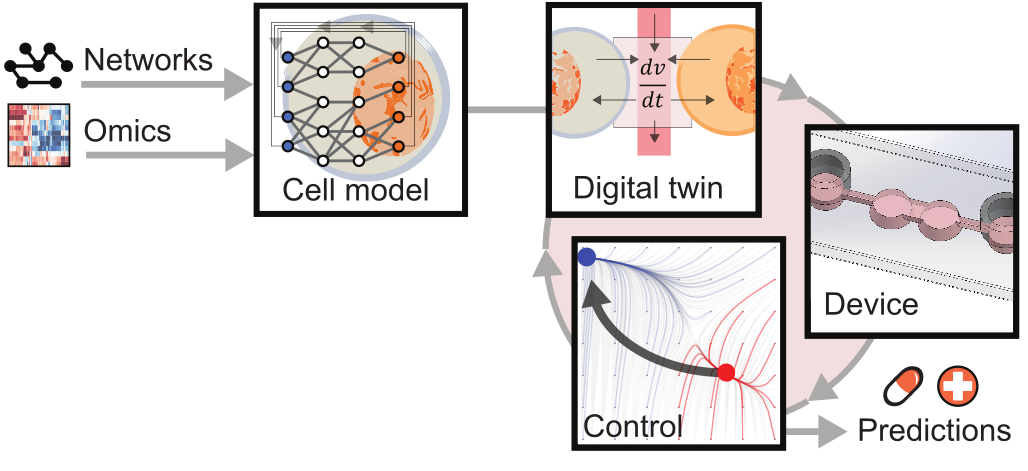
Cancer progression is driven not only by genetic alterations within individual cells but also by complex communication between cancer cells and their surrounding microenvironment. Understanding and controlling these interactions would enable therapies that disrupt cancer-promoting cellular equilibria, improve treatment design, and accelerate precision medicine. The major technical challenge is to develop predictive computational models that capture high-dimensional, nonlinear cell-cell interactions and reliably forecast the effects of targeted interventions. A promising path to address this challenge is to combine biological knowledge on cellular signaling and regulatory mechanisms with recent advances in AI and dynamical systems theory. This would entail learning biologically consistent models of multicellular behavior, validated and enriched on micro-physiological systems.
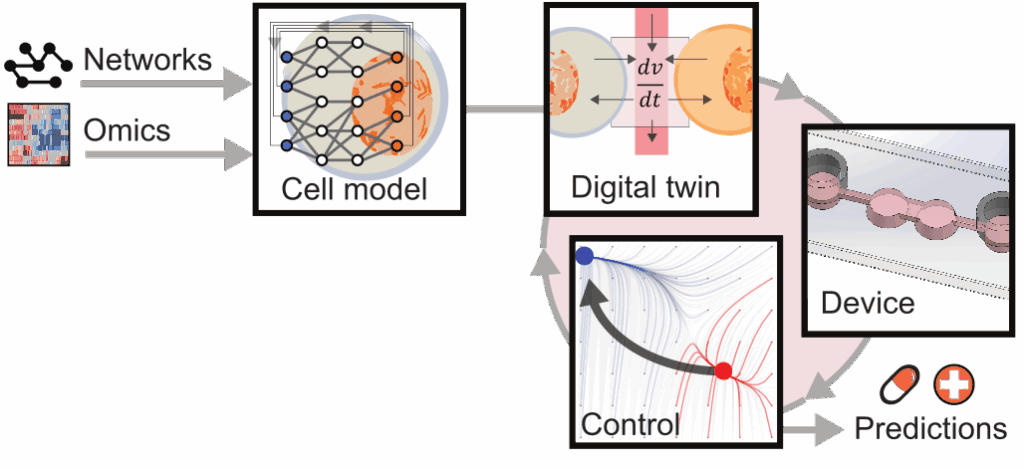
As a first approach, we focus on communication between pancreatic cancer cells and stromal cells, whose reciprocal interactions are known to reinforce tumor growth and therapeutic resistance. While recent single-cell technologies provide unprecedented measurements of cellular states and signaling pathways, these data remain largely observational and therefore have limited predictive power for designing interventions. Moreover, existing AI approaches rarely account for the coupled dynamics governing cellular communication, making the identification of stable and controllable cellular states particularly challenging. This motivates our project, SCALE, to develop biology-informed AI methods for modeling and controlling multicellular systems. The objectives of SCALE are to establish the fundamental theory and computational tools needed to learn predictive models of cell-cell interactions, to identify healthy and disease-associated equilibria, and to design optimal in silico interventions to guide experimental validation and future therapeutic development.
Background
Cells continuously exchange signaling molecules to create the cellular microenvironment. In pancreatic cancer, communication between cancer cells and surrounding stromal cells regulates processes such as tumor growth and therapeutic resistance. In reality, these cell-cell interactions are not directly observed. Instead, they are studied through molecular measurements and cell culture experiments that capture the cellular states resulting from these interactions. Therefore, it is difficult to directly characterize the interaction mechanisms and predict how perturbations of one cell population influence the others.
The functional relationship between cell-cell interactions and the observed cellular states is governed by complex biological processes involving intracellular signaling and intercellular communication. For multicellular systems such as the pancreatic tumor microenvironment, these coupled dynamics remain difficult to characterize because of the large number of interacting molecules and feedback mechanisms. Furthermore, experimental observations are inherently noisy and capture only part of the underlying biological processes.
Naturally, modeling and predicting the coupled dynamics that govern cell-cell interactions from experimental observations constitute a challenging systems modeling problem.
Cross-disciplinary collaboration
The project will combine methods and techniques from separate research fields – (a) biological knowledge about virtual cell models and computational biology, (b) dynamical system and control theories, (c) micro physiological systems design, and experiments.