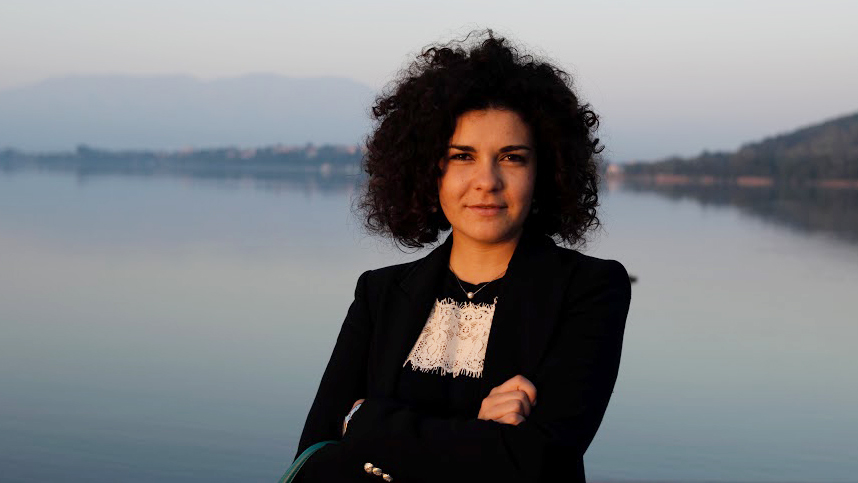
A new opinion piece co-authored by Digital Futures postdoctoral researcher Francesca Larosa was published on 28 March in Nature Sustainability, introducing a groundbreaking concept: the Earth alignment principle for artificial intelligence (AI). Larosa, a Marie Skłodowska-Curie Fellow at KTH and affiliated with the KTH Climate Action Centre, contributed to this international effort aimed at aligning AI development with planetary sustainability goals.
The article – titled “The Earth alignment principle for artificial intelligence” – is the outcome of a closed-door workshop convened by the US National Academy of Sciences, Nobel Prize Outreach, and Microsoft, following the Nobel Prize Summit Truth, Trust and Hope held in Washington D.C. in May 2023. Larosa was among the invited participants, recognized for her research on the climate and sustainability impacts of AI.
The Earth alignment principle is introduced at a critical juncture: 25 of the 35 monitored vital climate signals are breaking records, and six of nine planetary boundaries have already been transgressed. Amidst increasing conflict, biodiversity loss, and global polarization, the piece argues that transformative technologies like AI must be steered intentionally to support equitable and sustainable futures.
To this end, the principle is structured around three pillars:
- Controlled growth – to prevent AI from reinforcing unsustainable consumption and production patterns.
- Equitable access – ensuring AI tools and systems benefit all, not just a privileged few.
- Social cohesion – fostering strong governance and trust in AI’s role in society.
The commentary is led by Owen Gaffney (Impact Officcer, Nobel Prize), and co-authored by experts in the field including the Senior Director at the US National Academy of Sciences, the Global Head of Sustainability at Microsoft, the President of the European Research Council and Virginia Dignum, member of the United Nation’s High-Level Advisory Body on Artificial Intelligence.
Read the full piece here: Nature Sustainability