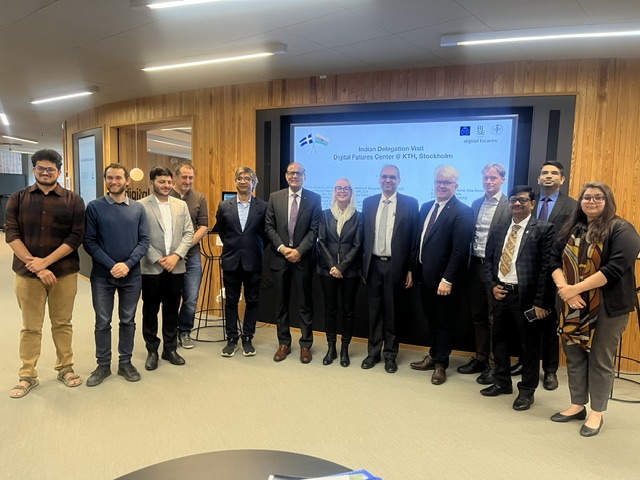
Robert Johansson is an Associate Professor at Stockholm University and a faculty member at Digital Futures. He is the creator of Machine Psychology, a new interdisciplinary field that combines insights from learning psychology and adaptive AI systems. His research in Artificial General Intelligence (AGI) explores how cognitive processes, specifically Arbitrarily Applicable Relational Responding (AARR), can be modeled using the Non-Axiomatic Reasoning System (NARS). In clinical psychology, his work spans diverse topics, with a special focus on emotion-focused psychotherapy models.
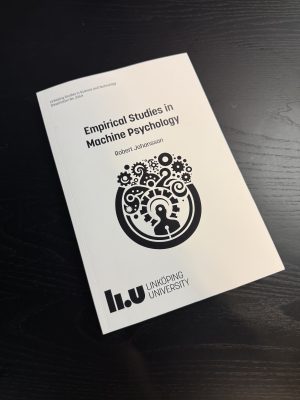
On November 21, 2024, Robert Johansson presented his second PhD thesis, this time in computer science, titled Empirical Studies in Machine Psychology, at Linköping University. This work showcased his innovative approach to integrating psychology and computational models in AGI research, building on his prior interdisciplinary achievements. View the presentation on Youtube!
Your thesis introduces Machine Psychology as a novel interdisciplinary paradigm. What inspired you to synthesize learning psychology with the Non-Axiomatic Reasoning System (NARS), and how does this approach differ from traditional methods in AGI research?
– The foundation of Machine Psychology was inspired by my deep interest in Arbitrarily Applicable Relational Responding (AARR), a core process in human cognition that underlies our ability to form abstract, context-independent relationships. AARR fascinated me because it captures the essence of how humans derive complex reasoning and adapt flexibly to novel situations. This interest naturally led me to explore how such processes could be modeled computationally.
Integrating AARR with NARS was a logical step, as NARS’s design philosophy aligns closely with principles from learning psychology. NARS’s focus on reasoning under uncertainty and limited information provided an ideal platform for modeling the flexibility and generalization inherent in AARR. Machine Psychology emerged as a framework that combines the adaptive reasoning capabilities of NARS with the relational principles of learning psychology, modeling cognitive processes that are both generalizable and context-sensitive. This interdisciplinary approach represents a shift toward understanding and modeling intelligence as general and flexible, rather than task-specific.
Your thesis details a progression of empirical studies using psychological experimental paradigms to explore complex cognitive behaviors in NARS. How did adapting psychological experimental paradigms for use with NARS influence the design or development of the system, and what does this reveal about the relationship between human cognition and artificial intelligence?
– Adapting psychological experimental paradigms for use with NARS shaped the system’s architecture and functionality, requiring it to implement key aspects of human cognitive flexibility. For instance, paradigms like operant conditioning and relational responding emphasized the need for NARS to process dynamic feedback, temporal dependencies, and abstract relational patterns. These adaptations not only refined NARS’s reasoning mechanisms but also highlighted the critical role of psychological theories in guiding AI design.
This process revealed a profound integration of theoretical perspectives: the learning and relational principles that shape human cognition can also serve as a blueprint for developing adaptive, general-purpose AI systems. By drawing on insights from psychology, Machine Psychology demonstrates how interdisciplinary approaches can deepen our understanding of both human intelligence and Artificial General Intelligence.
How did your involvement with Digital Futures support or influence the development of your thesis? Were there specific collaborations, resources, or ideas from this environment that played a key role?
– Digital Futures played a pivotal role in supporting this research by providing funding and fostering an interdisciplinary environment that was essential for the growth of Machine Psychology. The funding allowed us to recruit key collaborators, conduct empirical studies, and organize the AGI-2023 conference, which brought together leading researchers to discuss advancements in Artificial General Intelligence.
This conference, along with other activities facilitated by Digital Futures, fostered invaluable collaborations and showcased the relevance of Machine Psychology as a groundbreaking paradigm. Additionally, access to their network of experts and cutting-edge resources enriched the research, underscoring the transformative impact of interdisciplinary support on advancing AGI.
Your research highlights Machine Psychology as a promising framework for advancing AGI. Looking ahead, what are the next steps for this paradigm, and how do you envision its adoption or expansion within the AGI community?
– The next steps for Machine Psychology involve refining and scaling its principles. This includes developing more advanced implementations of Arbitrarily Applicable Relational Responding (AARR) in systems like NARS and testing these capabilities in increasingly complex, real-world scenarios. Expanding interdisciplinary collaborations, particularly with researchers in Relational Frame Theory, computational neuroscience, and robotics, will be crucial to grounding these developments in both psychological theory and practical applications.
Building a broader community of researchers and practitioners will also be key to applying Machine Psychology principles to real-world challenges. For example, this framework could revolutionize adaptive AI in education by tailoring learning pathways to individual needs or enhance AI’s ability to model complex human emotions for more empathetic psychotherapy tools.
Ultimately, Machine Psychology aims to redefine how we design and understand intelligent systems, ensuring they align with human values and societal needs. By fostering interdisciplinary collaborations and addressing real-world challenges, it can become a foundational framework for adaptive, ethical, and human-aligned AI systems.
Links to presentation:
- Empirical Studies in Machine Psychology – PhD thesis (Diva)
- Empirical Studies in Machine Psychology – presentation (Youtube)