

About the project
Objective
The objective of this project is to develop an AI-enabled, fully self-powered, and biodegradable wound-healing patch that accelerates tissue regeneration and enables continuous monitoring of post-cardiac-surgery wounds. The system combines triboelectric nanogenerators (TENGs) for bioelectric stimulation with AI-based image analysis to provide personalized, sustainable, and real-time wound care without external power sources.
Background
Post-cardiac-surgery wounds face high risks of infection, delayed healing, and limited continuous monitoring. Existing wound-care technologies rely on external power sources, are costly, and lack portability. Triboelectric nanogenerators (TENGs) offer a promising alternative by harvesting biomechanical energy from natural body movements to deliver gentle bioelectric stimulation.
This project integrates biodegradable hydrogels with antibacterial and anti-inflammatory properties and AI-driven wound image analysis to assess healing stages such as inflammation, proliferation, and remodeling. The approach reduces electronic waste, enables continuous monitoring, and supports faster, safer recovery through sustainable digital healthcare solutions.
About the Digital Futures Postdoc Fellow
Swati Panda is a postdoctoral researcher at the Department of Biomedical Engineering and Health Systems at KTH, specializing in biocompatible and biodegradable energy-harvesting devices for self-powered healthcare applications. She holds a PhD in Robotics and Mechatronics Engineering from DGIST, South Korea. Her research focuses on triboelectric and piezoelectric nanogenerators, biodegradable/biocompatible polymers, and AI-based signal and image processing for healthcare sensing.
She has extensive experience in material synthesis, device fabrication, in-vivo experimentation, and self-powered health monitoring systems. Through her work, she aims to develop sustainable, wearable, and smart healthcare technologies that improve patient outcomes while reducing environmental impact.
Main supervisor
Seraina Dual, Assistant Professor, Department of Biomedical Engineering and Health Systems, KTH Royal Institute of Technology.
Co-supervisor
Erica Zeglio, Assistant Professor, Department of Chemistry, Stockholm University.
About the project
Objective
WWF Sweden’s One Planet Plate (OPP) offers chefs, caterers and consumers a practical guide to climate- and biodiversity-aligned meals, underpinned by a “cradle-to-plate” database and a 0.5 kg CO₂e/meal threshold. Despite early uptake by more than twenty restaurants and public institutions, OPP faces challenges, such as data and methodological inconsistencies, trust issues and scale-up barriers.
Addressing these challenges, our project aims to shed light on the following research questions:
- How and under which conditions can the OPP software diffuse and drive transitions toward economically and environmentally sustainable business models of restaurants?
- How can the methodological foundations and user-facing functionalities of the OPP tool be critically evaluated and improved, e.g., through uncertainty communication or AI integration, to better support climate- and biodiversity-aligned food practices?
- How and under which conditions can stakeholder engagement and cooperation foster mutual learning and inform the future direction of data-driven sustainability tools in food services?

Background
As datafication and artificial intelligence reshape decision-making, including in food services,One Planet (OPP) initiative offers an early real-world testbed. In our project, we will providean in-depth study of OPP – one of frontrunners among data-driven sustainable food initiatives worldwide – advancing understanding of the potential of digital tools to foster climate- and biodiversity-aligned consumption.
We apply a transdisciplinary lens – exploring methodological robustness, user experience, scalability and business feasibility – through close collaboration between researchers, tool developers, data providers, chefs and other users.
Crossdisciplinary collaboration
The researchers in the team represent the Department of Industrial Economic and Management (INDEK) at ITM/KTH and the Department of Sustainable Development, Environmental Science and Engineering (SEED) at ABE/KTH as well as KTH Food Centre.
About the project
Objective
This research project aims to develop, implement, and validate an integrated AI-based predictive maintenance and life cycle assessment framework for smart buildings. Using the KTH Live-In Lab, a highly instrumented student residential facility in Stockholm, as a testbed, the project will leverage real-time data from over 150 sensors collecting data every 10 minutes to model degradation in HVAC, piping, and other technical systems. The goals are to:
- develop accurate machine learning models for predictive maintenance,
- link these models to dynamic LCA to estimate the net environmental and economic impacts, including the extension of building component lifespans and cost savings,
- evaluate trade-offs in sensor deployment.
- identify an optimal balance between performance improvement and environmental footprint.
Background
Buildings account for a significant portion of global energy consumption and greenhouse gas emissions, making them a critical focus for sustainability efforts. Digital solutions, such as building monitoring systems, provide opportunities to optimize energy use and operational efficiency. However, their environmental implications, including production, operation, and disposal, remain largely underexplored. This interdisciplinary research aims to address this gap by developing, implementing, and validating a novel framework that combines predictive maintenance with LCA. This framework will quantify the net environmental impacts of Information and Communication Technology (ICT) systems in buildings, offering a comprehensive approach to assess both benefits and burdens.
The project leverages the KTH Live-In Lab, a student housing testbed in Stockholm equipped with over 150 sensor data points recorded every 10 minutes, to harness real-time data and advanced machine learning algorithms. These tools will predict failures in building subsystems, such as heating, ventilation, and piping systems, with the goal of extending their functional lifespan, reducing maintenance costs, and optimizing energy and material use. Using LCA methodology, the study will critically evaluate the environmental costs of digital infrastructures, including sensors and communication hardware across their lifecycle. By introducing dynamic feedback between maintenance strategies and environmental performance, the project will provide insights into direct impacts and broader trade-offs, supporting sustainable building practices.
Crossdisciplinary collaboration
This project introduces a novel integration of AI-based predictive maintenance with real-time LCA modeling, which is bridging gaps between building engineering, environmental science, and digitalization. The collaboration between the research team enables the assessment of both operational performance and environmental trade-offs, producing actionable insights for industry and policy. With established access to the KTH Live-In Lab, the team benefits from a high-resolution sensor network and a sophisticated BMS, essential for testing and validating predictive models. Additionally, tools such as SimaPro/OpenLCA and KTH’s computing infrastructure support advanced modeling and simulations.
About the project
Objective
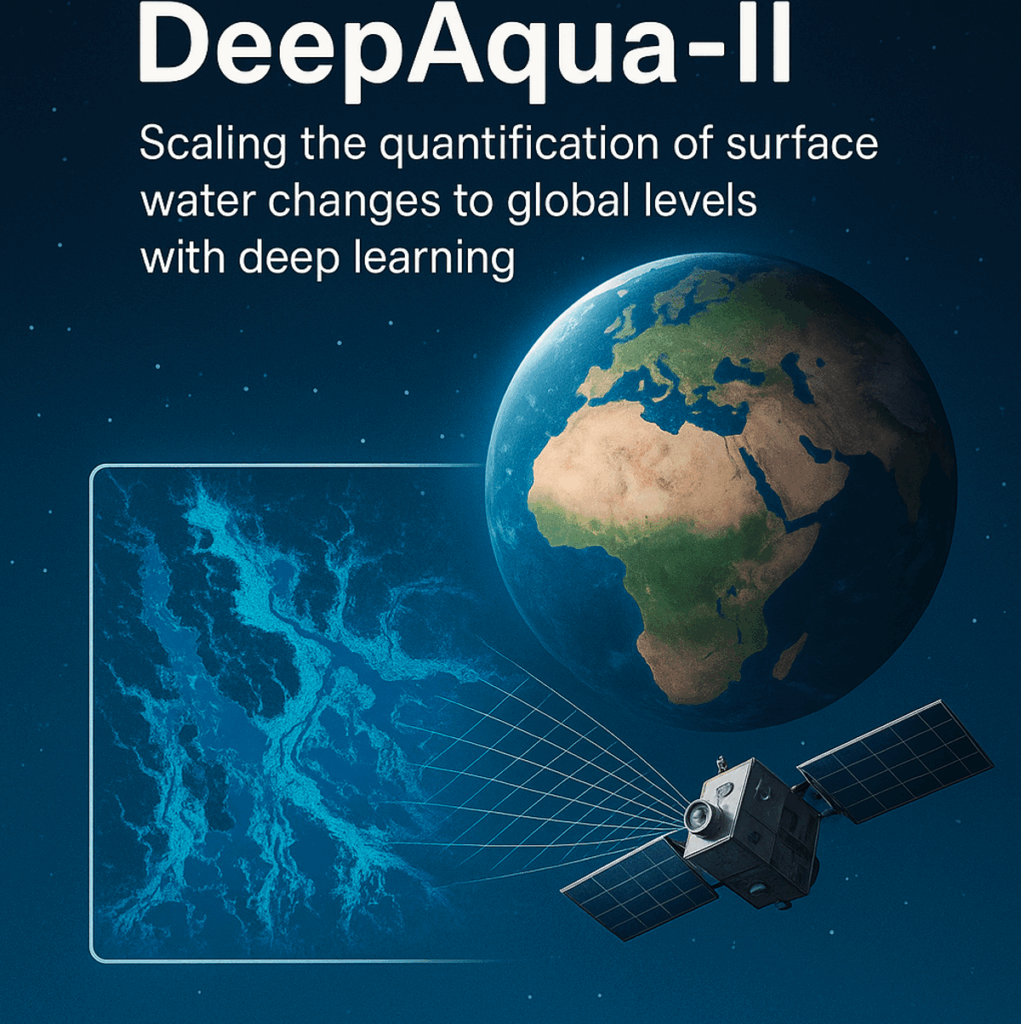
To develop DeepAqua-II, a robust, scalable deep-learning system for global surface-water monitoring using SAR time-series data.
Specific objectives (O1–O5):
- O1: Design a technique to normalize SAR pixel intensity values so models remain resilient to sensor adjustments.
- O2: Build a self-supervised semantic segmentation model using SAR time-series without needing optical data.
- O3: Add support for L-band SAR sensors to detect water under vegetation.
- O4: Quantify changes in surface-water extent across multiple climate regions for 2015–2027.
- O5: Communicate and disseminate results to maximize impact, including training and capacity building.
Background
Surface water is declining worldwide, requiring more accurate monitoring.
- Traditional monitoring depends on optical satellite imagery, which fails under clouds and vegetation.
- Existing SAR-based models require manual annotations and retraining whenever sensors change.
- The earlier DeepAqua project achieved strong performance but still depends on optical data and lacks resilience to sensor adjustments.
- The upcoming NISAR mission introduces L-band SAR, enabling deeper vegetation penetration.
- There is a global need for automated, scalable, optical-independent methods for long-term water-extent mapping.
Crossdisciplinary collaboration
Hydrology & Environmental Sciences
- Led by Professor Zahra Kalantari
- Expertise in water resources management, hydrology, climate-change impacts, and sustainability.
Computer Science & Machine Learning
- Led by Associate Professor Amir H. Payberah
- Expertise in scalable machine learning, deep learning, and time-series modeling.
Nature of collaboration
- Integrates SAR remote sensing, deep learning, and climate/land-water systems.
- Builds on joint results from DeepWetlands and DeepAqua.
- Enables a cooperative system for global-scale water monitoring.
About the project
Objective
The primary objective of this research is to discover methods for autonomously generating threat intelligence (TI) that empowers users to gain a competitive advantage over threat actors. The central focus of the study involves designing and developing LLM-powered telemetry systems, including web scrapers and honeypots, that are immune to AI-based attacks. These systems are instrumental in collecting early threat signals. Furthermore, a significant aspect of the project involves utilizing a comprehensive set of Large Language Model (LLM)-driven advanced analytics to generate actionable threat insights that elucidate the nature of the attacks.
Background
The world of cyber threat intelligence (CTI) is undergoing a profound transformation due to the emergence of AI-based cybercrime chatbots, attack agents, and malware. Traditional CTI solutions have proven ineffective against AI-powered exploit kits, necessitating the design of end-to-end AI-agents capable of reasoning threat intelligence in a ubiquitous fashion. While a significant number of academic papers were published on LLM-driven CTI techniques by 2025, these studies must be evaluated based on the national context.
Since AI-based threats pose a significant and tailored threat to every nation, the development of counter-AI systems from a national perspective as well as providing an opportunity for researchers to be equipped with AI in CTI expertise is crucial.
Crossdisciplinary collaboration
The researchers in this team hail from the Royal Hacking Lab at Cybercampus Sweden, the Division of Network and System Engineering (EECS/NSE) at KTH Royal Institute of Technology, and the Cybersecurity Unit at RISE Research Institutes of Sweden.
Upon successful completion of the research, the anticipated users include the Swedish Computer Emergency Response Team (CERT-SE) at MSB, the Cyber Defense Unit under the Division of Cyber Defence and C2 Technology at the Swedish Defence Research Agency (FOI), and the National Operations Department (NOA) at the Police Authority.
About the project
Objective
SambIoT provides strong solutions for secure and scalable 6G-enabled Ambient IoT, while being cognizant of sustainability. We pursue fundamental research on key enablers for scalable security for Ambient IoT. Our technical objectives are:
- System support and backscatter infrastructure for Ambient IoT devices
- Lightweight physical layer techniques for 6G network security
- Automated, large-scale deployment of Ambient IoT applications and data analysis via confidential computing in cloud-edge environments
- Scalable credential management as a service

Background
6G promises to revolutionize connectivity for billions of Internet of Things (IoT) devices with ultra-fast data, near-zero latency, far surpassing 5G. Ambient IoT, a central component of 6G, will enable a wide range of new IoT applications across industries; for smart cities, agricultural and environmental monitoring, smart and ubiquitous healthcare, environmental sustainability by advanced waste and resource management.
Scalability and security are the keys to the success of Ambient IoT. The promised vast device numbers and interconnectedness require efficient, reliable data processing solutions. Cloud and edge computing play a vital role in this context by handling computationally intensive tasks IoT devices cannot manage and enabling security-relevant tasks, from credential management support to secure data storage and processing.
Without security, many applications with high societal value (e.g., healthcare and smart grid) will not be deployed. Scaling applications with the number of devices increases measurement points, which, e.g., in smart buildings, leads to better control and hence larger energy savings. Moreover, devices themselves contribute to enhanced sustainability, running without batteries thereby reducing toxic waste, with more sustainable electronics and materials for future implementations.
Cross-disciplinary collaboration
The project develops basic 6G security and privacy technologies, along with enhanced capabilities for AI, smart cities, and healthcare. Ambient IoT per se contributes to enhanced sustainability.
PIs of the project
Panos Papadimitratos, Professor, KTH, EECS
Thiemo Voigt, Professor, RISE Computer Science
Musard Balliu, Associate Professor, KTH, EECS
About the project
Objective
This project aims to develop and demonstrate AgentVision, a novel video–language model that combines video-based deep learning with multimodal large language model (mLLM) reasoning to enhance environmental perception for autonomous driving. Focusing on pedestrian crossing intention prediction, the project includes developing and training AgentVision using open datasets, deploying it on KTH’s Research Concept Vehicle (RCV-E) at ITRL, and testing it at the Arlanda track. Through integration of contextual reasoning and real-time perception, the project seeks to improve safety, robustness, and trust in autonomous vehicle systems, providing a blueprint for future intelligent and cooperative mobility solutions.
Background
Autonomous vehicles (AVs) depend on visual perception for situational awareness, yet existing systems face major challenges in complex real-world environments. Traditional vision models struggle with limited visibility, occlusions, and ambiguous interactions among multiple agents. Moreover, deep learning-based perception relies heavily on large, high-quality datasets, limiting robustness and generalization in diverse traffic conditions. These challenges hinder accurate understanding of pedestrian behaviors and other dynamic elements essential for safe navigation. Therefore, developing more adaptable and context-aware perception systems is crucial to enhance reliability, interpret complex scenes, and ensure safety in intelligent transportation and autonomous driving applications.
Crossdisciplinary collaboration
The project is an interdisciplinary collaboration among KTH’s ABE, SCI, EECS schools and a startup company FleetMQ, integrating transport science and causal AI expertise to advance intelligent mobility innovation.
PI: Zhenliang Ma
Co-PI: Mikael Nybacka