

About the project
Objective
The Decision-making in Critical Societal Infrastructures (DEMOCRITUS) project develops methods for monitoring and controlling large-scale infrastructures with the help of digitalization. We design new methods for learning over large datasets, propose networking solutions that support monitoring, learning and control, and construct data-driven models of the monitored physical processes. As an application, Democritus focuses on the water distribution systems, which exhibit many unsolved challenges for future societal systems. We study real-time leak detection, detection and mitigation of possible contamination or attacks, global decision-making while observing local data privacy, and the efficient utilization of smart meters.
Background
The Smart Society critically depends on large infrastructures like electrical grids or water distribution networks that need to operate efficiently, with predictable performance and meet strict safety and security requirements. They must also be able to make informed decisions under constraints and in real time – one simple error can have devastating consequences. Despite their technological diversity, the digitalization of these infrastructures can follow a common set of novel design principles.
Cross-disciplinary collaboration
The team consists of experts from the School of Electrical Engineering and Computer Science and the School of Engineering Sciences at KTH, from Stockholm University and from RISE with research experience in network design and optimization, learning and decision making, security of cyber-physical systems, and large-scale experimentation.
Activities & Results
Find out what’s going on!
Activities, awards, and other outputs
- Viktoria Fodor and Carlo Fischione gave invited tutorials on the project result at several top IEEE conferences, including IEEE ICC 2022 and IEEE Globecom 2022
- Henrik Sandberg gave plenary talks on the security and safety of networked control systems at SAFEPROCESS 2022 and the DISC Summer School 2022.
- Digital Futures Seminar – Decision Making in Critical Societal Infrastructures, 2020, Oct 20, https://www.digitalfutures.kth.se/event/df-seminar-decision-making-in-critical- societal-infrastructures/
- Democritus Stakeholder Workshop, 2021, Nov 24, https://www.digitalfutures.kth.se/event/decision-making-for-water-distribution-networks- open-workshop-of-the-democritus-project/
- Workshop co-organized by Digital Futures – KTH WaterCentre, on Sensor Technologies for Clean Water, 2022 April 6, www.digitalfutures.kth.se/event/workshop-on-sensor-technologies-for-cleaner-water/
- Presentation at the Digital Futures Research Day, 2022, April 21, https://www.digitalfutures.kth.se/event/digital-futures-open-research-day-21-april-2022/
- Digitalize in Stockholm, presentations in 2021 and 2022, https://digitalizeinsthlm21.se/, https://digitalizeinsthlm22.se/
- Bengt Ahlgren and Viktoria Fodor organized the 2022 Swedish National Computer Networking Workshop, sponsored by Digital Futures. 2022 June 16/17. Several of the project results were also presented, http://www.sncnw.se/2022/
- Viktoria Fodor chaired IEEE International Conference on Sensing, Communication, and Networking (SECON) 2022.
- Carlo Fischione chairs the Wireless Communications for Distributed Intelligence workshop at IEEE Global Communications Conference (GLOBECOM) 2022.
- Carlo Fischione chairs the Symposium on Selected Areas in Communications: Machine Learning for Communications and Networking Track at IEEE International Conference on Communications (ICC) 2023.
Results
Results from three main areas of research include dimensioning of network and learning resources for distributed learning, wireless protocols for supporting machine learning, and methods to localise leaks in water networks from passively collected data. A stakeholder workshop on the project’s topic was organised in 2021 with participation from the public and private sectors, and collaboration with water distribution companies and the KTH Water Centre has been strengthened.
Publications
We like to inspire and share interesting knowledge!
Water distribution networks
DP Souza, R Du, B da Silva Jr, J Mairton, CC Cavalcante, C Fischione, Leakage Detection In Water Distribution Networks: Efficient Training By Data Clustering, IWA World Water Congress & Exhibition 2022.
DP Sousa, R Du, J Mairton Barros da Silva Jr, CC Cavalcante, C. Fischione, “Leakage detection in water distribution networks using machine-learning strategies”, Water Supply 23 (3), 1115-1126, 2023.
L. Lindström, S. Gracy, S. Magnússon and H. Sandberg, “Leakage Localization in Water Distribution Networks: A Model-Based Approach”, European Control Conference, 2022.
M. Mascherpa, I. Haasler, B. Ahlgren, J. Karlsson: “Estimating pollution spread in water networks as a Schrödinger bridge problem with partial information.” Accepted for publication in European Journal of Control.
Cyber-physical systems
M, Zhang, Q. Xu, S Magnússon, R. Pilawa-Podgurski and G. Guo, “Multi-Agent Deep Reinforcement Learning for Decentralized Voltage-Var Control in Distribution Power System”, IEEE Energy Conversion Congress and Exposition, 2022.
D Weinberg, Q Wang, TO Timoudas, C Fischione, “A review of reinforcement learning for controlling Building Energy Systems from a computer science perspective”, Sustainable Cities and Society, 104351,3, 2022.
Bengt Ahlgren. Simulator Framework for Developing Decision-Making Methods for Critical Infrastructure. In 18th Swedish National Computer Networking and Cloud Computing Workshop (SNCNW 2023), Kristianstad University, Kristianstad, June 14-15, 2023.
Large-scale and distributed learning and optimization
A. Alanwar, A. Berndt, K.H. Johansson and H. Sandberg, “Data-Driven Set-Based Estimation Using Matrix Zonotopes with Set Containment Guarantees”, European Control Conference, 2022.
X. Wu, S. Magnússon, H. Reza Feyzmahdavian, M. Johansson, “Optimal convergence rates of totally asynchronous optimization”, IEEE Conference on Decision and Control (CDC), 2022.
X. Wu, S. Magnússon, H. Reza Feyzmahdavian, and M. Johansson, “Delay-adaptive step-sizes for asynchronous learning” International Conference on Machine Learning (ICML), 2022.
TO Timoudas, S Zhang, S Magnússon, C Fischione, ”A General Framework to Distribute Iterative Algorithms with Localized Information over Networks”, IEEE Transactions on Automatic Control, 2023.
S. Vaishnav and S. Magnússon, “Energy-Efficient and Adaptive Gradient Sparsification for Federated Learning” 2023 IEEE International Conference on Communications (ICC), Rome, Italy, 2023.
S. Vaishnav and S. Magnússon, “Intelligent Processing of Data Streams on the Edge Using Reinforcement Learning” 2023 IEEE International Conference on Communications Workshops (ICC), Rome, Italy, 2023
I. Haasler, A. Ringh, Y. Chen, J. Karlsson, “Multi-marginal optimal transport with a tree-structured cost and the Schroedinger bridge problem,” SIAM Journal on Control and Optimization, 59(4), 2428-2453, 2021.
I. Haasler, J. Karlsson, and A. Ringh, “Control and estimation of ensembles via structured optimal transport, A computational approach based on entropy-regularized multi-marginal optimal transport,” IEEE Control Systems Magazine 41 (4), 50-69, 2021.
I. Haasler, A. Ringh, Y. Chen, and J. Karlsson, “Efficient computations of multi-species mean field games via graph-structured optimal transport,” IEEE Conference on Decision and Control, 2021.
J. Fan, I. Haasler, J. Karlsson, and Y. Chen, “On the complexity of the optimal transport problem with graph-structured cost,” AISTATS, 2022.
I. Haasler, A. Ringh, Y. Chen, J. Karlsson, “Scalable computation of dynamic flow problems via multi-marginal graph-structured optimal transport” Accepted for publication in Mathematics of Operations Research.
Networking for/with machine learning
H. Hellström, V. Fodor and C. Fischione, “Over-the-Air Federated Learning with Retransmissions,” IEEE 22nd International Workshop on Signal Processing Advances in Wireless Communications (SPAWC), 2021.
H. Hellström, V. Fodor, C. Fischione, “Unbiased Over-the-Air Computation via Retransmissions,” IEEE , Global Communications Conference (GLOBECOM), 2022.
S Razavikia, JA Peris, JMB Da Silva, C Fischione, “Blind Asynchronous Over-the-Air Federated Edge Learning”, 2022 IEEE Globecom Workshops (GC Wkshps), 1834-1839, 2, 2022.
H Hellström, JMB da Silva Jr, MM Amiri, M Chen, V Fodor, HV Poor, C. Fischione, “Wireless for machine learning: A survey”, Foundations and Trends® in Signal Processing 15 (4), 290-39916, 2022.
P Park, P Di Marco, C Fischione, Optimized over-the-air computation for wireless control systems, IEEE Communications Letters 26 (2), 2022.
Z Chen, EG Larsson, C Fischione, M Johansson, Y Malitsky, Over-the-Air Computation for Distributed Systems: Something Old and Something New, IEEE Networking Magazine, 2023.
H Hellström, V Fodor, C Fischione, “Federated Learning Over-the-Air by Retransmissions”, IEEE Transactions on Wireless Communications, 2023.
S Razavikia, JMB Silva Jr, C Fischione, “Computing Functions Over-the-Air Using Digital Modulations”, IEEE ICC 2023.
Y Kim, E Al Hakim, J Haraldson, H Eriksson, JMB da Silva, C Fischione, Dynamic clustering in federated learning, ICC 2021-IEEE International Conference on Communications, 1-610, 2021.
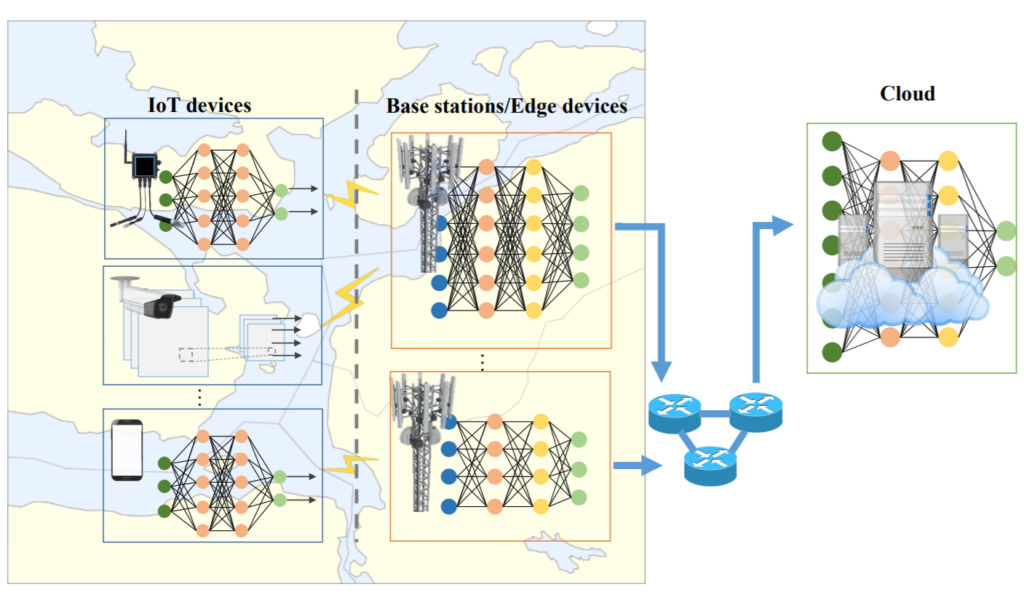
R Du, S Magnusson, C Fischione, The Internet of Things as a deep neural network, IEEE Communications Magazine 58 (9), 20-2511, 2020.
R Du, S Magnússon, C Fischione, The IoT as a Deep Neural Network, IEEE Communications Magazine, 2, 2020.
A Mahmoudi, HS Ghadikolaei, C Fischione, Cost-efficient distributed optimization in machine learning over wireless networks, ICC 2020-2020 IEEE International Conference on Communications (ICC), 1-77, 2020.
A Mahmoudi, HS Ghadikolaei, C Fischione, Machine learning over networks: co-design of distributed optimization and communications, 2020 IEEE 21st International Workshop on Signal Processing Advances in Communications.
X. Wang, F. S. Samani, and R. Stadler, “Online feature selection for rapid, low-overhead learning in networked systems,” 16th International Conference on Network and Service Management (CNSM 2020). IEEE, 2020.
R. S. Villaca and R. Stadler, “Online learning under resources constraints,” in 2021 17th IFIP/IEEE Symposium on Integrated Network and Service Management (IM 2021). IEEE, 2021.
X. Wang, FS. Samani, A. Johnsson,R. Stadler, “Online Feature Selection for Low-overhead Learning in Networked Systems (Demonstration),” In 2021 17th International Conference on Network and Service Management (CNSM) 2021 Oct 25 (pp. 527-529). IEEE, 2021.
X. Wang, R. Stadler, “Online Feature Selection for Efficient Learning in Networked System,” IEEE Transactions on Network and Service Management. 2022 Jun 8.
Network protocol design
P Park, P Di Marco, C Fischione, Wireless for control: Over-the-air controller, IEEE Communications Letters 25 (10), 3437-34411, 2021.
TO Timoudas, R Du, C Fischione, Enabling massive IoT in ambient backscatter communication systems, ICC 2020-2020 IEEE International Conference on Communications (ICC), 1-64 2020.
R Du, TO Timoudas, C Fischione, Comparing backscatter communication and energy harvesting in massive IoT networks, IEEE Transactions on Wireless Communications 21 (1), 429-4431, 2021.
P Park, HS Ghadikolaei, C Fischione, Proactive fault-tolerant wireless mesh networks for mission-critical control systems, Journal of Network and Computer Applications 186, 1030824, 2021.
M. Zeng, V. Fodor, Energy minimization for delay constrained mobile edge computing with orthogonal and non-orthogonal multiple access, Ad Hoc Networks, Vol. 98, 2020.
M. Zeng and V. Fodor, “Parallel Processing at the Edge in Dense Wireless Networks,” in IEEE Open Journal of the Communications Society, vol. 3, 2022.
J. A. Peris and V. Fodor, “Modelling multi-cell edge video analytics,” ICC 2022 – IEEE International Conference on Communications, 2022.
J. A. Peris and V. Fodor, “Distributed Join-the-Shortest-Queue with Sparse and Unreliable Information Updates,” ICC 2022 – IEEE International Conference on Communications, 2022.
B. Ahlgren, and K-J Grinnemo, “ZQTRTT: a multipath scheduler for heterogeneous traffic in ICNs based on zero queueing time ratio”, In Proceedings of the 9th ACM Conference on Information-Centric Networking (ICN ’22), 2022.
About the project
Objective
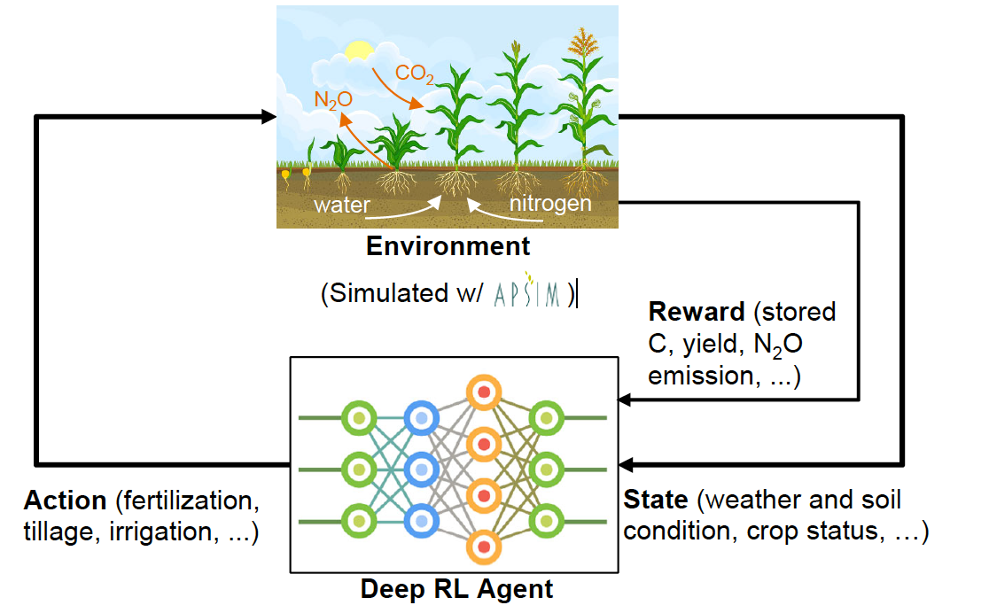
Soil carbon sequestration in croplands has tremendous potential to help mitigate climate change; however, it is challenging to develop optimal management practices to maximise the sequestered carbon and crop yield. This project aims to develop an intelligent agricultural management system using deep reinforcement learning (RL) and large-scale soil and crop simulations. To achieve this, we propose to build a simulator to model and simulate the complex soil-water-plant-atmosphere interactions, which will run on high-performance computing platforms.
Background
Massive simulations using such platforms allow the evaluation of the effects of various management practices under different weather and soil conditions in a timely and cost-effective manner. By formulating the management decision as an RL problem, we can leverage the state-of-the-art algorithms to train management policies, which are expected to maximise the stored organic carbon while maximising the crop yield. The whole system will be tested using data on soil and crops in both the mid-west of the United States and the Mediterranean region. The proposed research has great potential to impact climate change and food security, two of humanity’s most significant challenges.
Crossdisciplinary collaboration
This project is a collaboration between the University of Illinois at Urbana-Champaign, KTH Department of Sustainable Development and Stockholm University, Department of Physical Geography.
About the project
Objective
This project aims to address the voltage instability caused by a high ratio of renewables in sustainable power grids by making the control and coordination of converters of distributed energy resources more intelligent. To that end, we will leverage deep reinforcement learning to train data-driven and communication-efficient control policies that adapt to the fast fluctuation of renewable energy resources. We will train policies on advanced simulation environments and implement our AI algorithms on real microgrids in our lab at KTH. The developed control policies will allow converters to learn to optimize their interactions with the complex grid environment automatically and achieve a smooth integration of renewables without voltage security violations, thus promoting a climate-neutral society.
Background
Moving towards sustainability and climate security, electric power systems are going through a major paradigm shift with wide integration of distributed energy resources, such as solar PV, wind power, energy storage and electric vehicles. However, today’s grid cannot handle the rise in voltage and fast voltage fluctuations from the high penetration of renewables, which will cause a violation of grid security. Power converters of distributed energy resources have full controllability, promising to be utilized to address this challenge. At the same time, it is widely recognized that the lack of adequate control mechanisms to regulate the voltages is a key hindrance. We believe that AI and machine learning will play a key role in improving control strategies for converters by making them more adaptive and intelligent to stabilize complex and changing power grids.
Crossdisciplinary collaboration
This project is a collaboration with KTH EECS, Stockholm University and UC Berkeley.