About the project
Objective
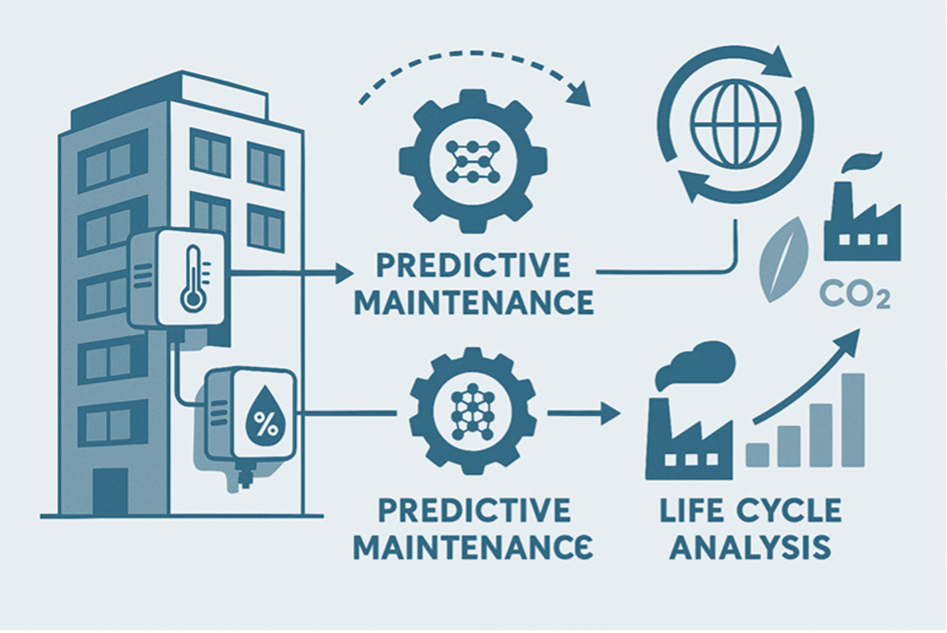
This research project aims to develop, implement, and validate an integrated AI-based predictive maintenance and life cycle assessment framework for smart buildings. Using the KTH Live-In Lab, a highly instrumented student residential facility in Stockholm, as a testbed, the project will leverage real-time data from over 150 sensors collecting data every 10 minutes to model degradation in HVAC, piping, and other technical systems. The goals are to:
- develop accurate machine learning models for predictive maintenance,
- link these models to dynamic LCA to estimate the net environmental and economic impacts, including the extension of building component lifespans and cost savings,
- evaluate trade-offs in sensor deployment.
- identify an optimal balance between performance improvement and environmental footprint.
Background
Buildings account for a significant portion of global energy consumption and greenhouse gas emissions, making them a critical focus for sustainability efforts. Digital solutions, such as building monitoring systems, provide opportunities to optimize energy use and operational efficiency. However, their environmental implications, including production, operation, and disposal, remain largely underexplored. This interdisciplinary research aims to address this gap by developing, implementing, and validating a novel framework that combines predictive maintenance with LCA. This framework will quantify the net environmental impacts of Information and Communication Technology (ICT) systems in buildings, offering a comprehensive approach to assess both benefits and burdens.
The project leverages the KTH Live-In Lab, a student housing testbed in Stockholm equipped with over 150 sensor data points recorded every 10 minutes, to harness real-time data and advanced machine learning algorithms. These tools will predict failures in building subsystems, such as heating, ventilation, and piping systems, with the goal of extending their functional lifespan, reducing maintenance costs, and optimizing energy and material use. Using LCA methodology, the study will critically evaluate the environmental costs of digital infrastructures, including sensors and communication hardware across their lifecycle. By introducing dynamic feedback between maintenance strategies and environmental performance, the project will provide insights into direct impacts and broader trade-offs, supporting sustainable building practices.
Crossdisciplinary collaboration
This project introduces a novel integration of AI-based predictive maintenance with real-time LCA modeling, which is bridging gaps between building engineering, environmental science, and digitalization. The collaboration between the research team enables the assessment of both operational performance and environmental trade-offs, producing actionable insights for industry and policy. With established access to the KTH Live-In Lab, the team benefits from a high-resolution sensor network and a sophisticated BMS, essential for testing and validating predictive models. Additionally, tools such as SimaPro/OpenLCA and KTH’s computing infrastructure support advanced modeling and simulations.