About the project
Objective
- Develop a high-fidelity simulator that replicates Swedish railway operations, including infrastructure, rolling stock, power supply, signalling, and realistic operating behaviour.
- Create and analyse operational scenarios using historical, live, or simulated data to support performance monitoring, strategic planning, and subsystem interactions.
- Design analysis and visualisation modules to evaluate railway performance, including delay propagation, energy use, track capacity, driver behaviour, and the impact of digital technologies (e.g., ATO, DAC, VC).
- Demonstrate use cases with external partners through performance analysis, disruption management, decision support, subsystem compatibility testing, and development of a scalable digital twin architecture.
Background
Railways are essential for achieving climate-neutral, energy-efficient, and resilient mobility. In Sweden, they are a key pillar of sustainable transport policy. However, increasing capacity demands, operational complexity, infrastructure ageing, and the need for digital transformation pose major challenges. Despite progress in technologies and predictive management, the sector still lacks integrated platforms for testing, real-time data use, and efficient planning.
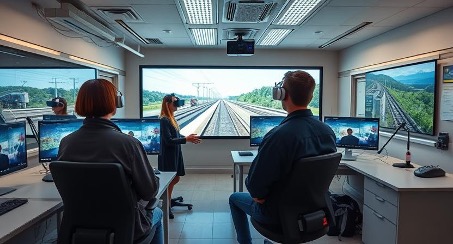
The SPOT-Rail project addresses these gaps by developing a cross-system railway demonstrator that replicates Swedish rail operations. At its core is a high-fidelity train driving simulator connected to live and historical data, supporting research, education, and strategic planning. This enables the testing of new technologies, evaluation of operational strategies, and development of decision-support tools.
By bridging research and real-world operations, SPOT-Rail promotes safer, more efficient, and environmentally friendly rail transport. It contributes to Sweden’s and Europe’s green transition goals while fostering innovation, collaboration, and a skilled workforce for the future of sustainable mobility.
Crossdisciplinary collaboration
The project brings together expertise from multiple disciplines to enable efficient and realistic simulation of railway operations. Key fields involved include: Railway systems engineering and train operations; Human factors and interaction design; Data science and artificial intelligence; Systems engineering. These disciplines contribute various theories, simulation modelling approaches, and machine learning algorithms for predictive analysis and decision support. Furthermore, the project aims to engage students by integrating its outcomes into university courses and offering opportunities for course projects and final theses. This strengthens the link between research, education, and practical application.