About the project
Objective
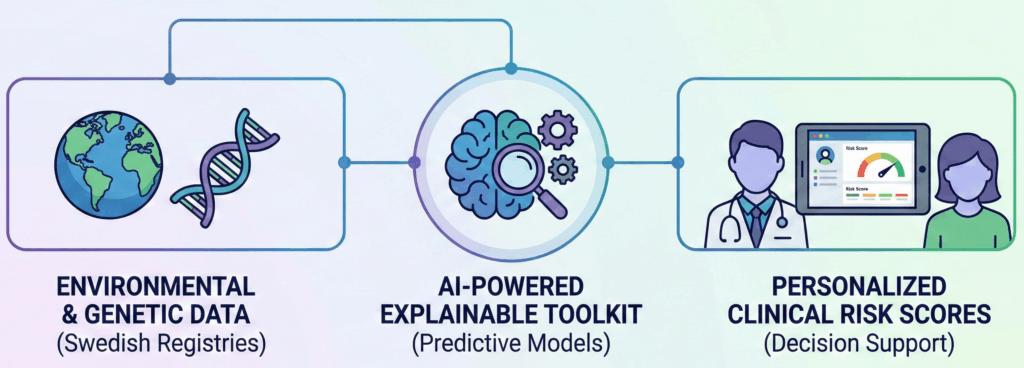
Breast and prostate cancers are among the most diagnosed cancers worldwide and in Sweden, arising from a complex interplay of genetic, environmental, and epigenetic factors. This project aims to develop an AI-powered, open-source, explainable toolkit that provides clinicians with a holistic and personalized assessment of breast and prostate cancer risk. By leveraging Swedish national health registries, we will capture key risk dimensions and integrate them into advanced predictive models capable of handling complex, interacting factors.
Specifically, the project will design and validate advanced predictive models to quantify the combined and individual contributions of multiple risk factors; implement a user-friendly, open-source Python toolkit that translates complex model outputs into actionable clinical risk scores and visualizations for decision support; conduct a clinical pilot in a regional setting to evaluate usability, functionality, and preliminary clinical utility in identifying individuals at elevated risk; and finally, formulate a strategy for national scaling and holistic integration, including a roadmap for incorporating genetic risk profiles from parallel projects, thereby paving the way for a comprehensive cancer risk assessment platform.
Background
Although high-risk inherited mutations (such as in BRCA1/2) are well known, they only explain a fraction of breast and prostate cancer cases. A large share of risk is instead driven by modifiable lifestyle factors acting through epigenetic mechanisms over the life course. Current clinical practice and many existing risk models still treat these factors in isolation and struggle to capture their cumulative, non-linear, and interacting effects. At the same time, Sweden maintains exceptionally rich national registries covering cancer diagnoses, healthcare utilization, prescriptions, demographic and socioeconomic data, and environmental conditions.
These data sources are ideal for characterizing the totality of non-genetic exposures but remain underused in integrated, clinically oriented tools. Traditional statistical methods often cannot cope with the high dimensionality and complexity of such data, while state-of-the-art AI and machine-learning approaches tend to function as “black boxes” that clinicians may be reluctant to trust in high-stakes decisions. This situation creates a clear gap for explainable, registry-driven AI that can bridge genetic and non-genetic risk into a transparent and usable decision-support tool.
Crossdisciplinary collaboration
The project is built around a research pair that combines expertise in computer science and AI with medical bioinformatics, epidemiology, and clinical cancer research.
Golnaz Taheri leads the development of advanced machine-learning models, explainable AI techniques, large-scale data processing, and the implementation of the open-source toolkit.
Arian Lundberg contributes expertise in medical bioinformatics, biomarker and translational research, epidemiology, and public health, ensuring that evaluations are clinically relevant and aligned with real-world cancer care. Together, this collaboration exemplifies a cross-disciplinary fusion of AI, digital health, and clinical cancer research, aiming to deliver tools that are both technically robust and directly applicable in healthcare and public health practice.
PI: Assist Prof. Golnaz Taheri, PhD, Knut and Alice Wallenberg & SciLifeLab DDLS Fellow, School of Electrical Engineering and Computer Science (EECS), KTH Royal Institute of Technology.
PI: Assist Prof. Arian Lundberg, PhD, Knut and Alice Wallenberg & SciLifeLab DDLS Fellow, School of Engineering Sciences in Chemistry, Biotechnology and Health (CBH), KTH Royal Institute of Technology.