About the project
Objective
The CARE-AI (Causal Adaptive Reasoning for Effective Hospital Admission Interventions) project aims to fundamentally change how hospitals prevent patient readmissions. Today’s AI systems can predict which patients are at high risk of readmission. However, they cannot tell doctors what to do to stop it.
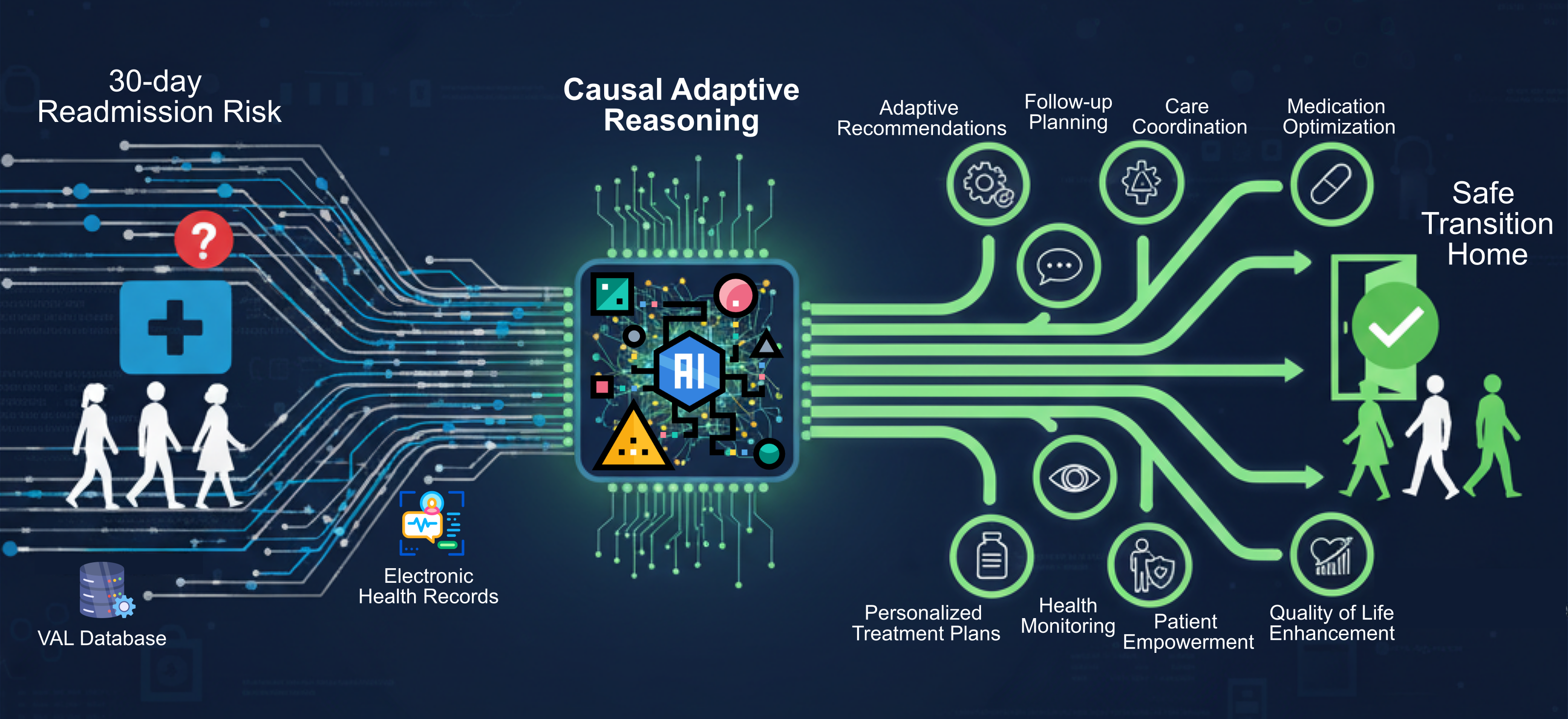
This project moves beyond simple prediction to intervention optimization. We are developing a framework using ‘causal AI,’ a method that identifies cause-and-effect relationships, to answer the most important question: ‘Which specific intervention will most benefit this specific patient to avoid readmission?’ Rather than only marking a patient as high-risk, the CARE-AI system will guide clinicians in choosing the best, personalized steps. This could mean adjusting medication, setting up a follow-up appointment, or offering education tailored to the patient.
The two-year project has two main phases. In the first phase, we will develop the core causal AI algorithms—AI methods that determine which actions cause better outcomes for which group of patients—using comprehensive, anonymized health data from Region Stockholm’s electronic health records (EHR) and the VAL databases (VAL is a regional healthcare data). In the second phase, we will conduct a Randomized Controlled Trial (RCT) at Södersjukhuset. In this trial, 250-300 high-risk patients will be randomized to receive either standard care or personalized interventions guided by the new causal AI framework.
The ultimate goal of the project is a clinically validated AI tool that provides clear, interpretable recommendations to healthcare staff, leading to fewer readmissions, better patient outcomes, and more efficient use of healthcare resources.
Background
Hospital readmissions are a critical and costly challenge for healthcare systems worldwide. In Sweden, 15.2% of all patients are readmitted to the hospital within 30 days. This figure rises to an alarming 28% for elderly patients with multiple chronic conditions.
The core problem is that many of these readmissions are preventable. The “one-size-fits-all” approach to discharge and follow-up isn’t effective. Current predictive AI models fall short because they are based on correlation, not causation. They can identify that a patient looks like other patients who were readmitted. But they can’t determine why or identify the specific, modifiable factor that would change the outcome for that individual.
This project tackles that fundamental gap. We’re moving from asking “Who is likely to be readmitted?” to “Who is likely to benefit from which intervention to avoid readmission?” By identifying the causal drivers of readmission, we can target interventions that make a real difference. With each hospital bed costing approximately 12,000 SEK per day, preventing unnecessary readmissions is crucial for a sustainable healthcare system.
Cross-disciplinary collaboration
The CARE-AI project is built on a “triple-helix” collaboration. This approach brings together world-class expertise from academia, clinical healthcare, and industry. This structure is essential to ensure the project is not only scientifically rigorous but also clinically relevant and practically implementable.
- KTH Royal Institute of Technology (Academia): Karl Henrik Johansson, Prof., and Umar Niazi, researcher, provide the project’s methodological leadership. They will develop novel causal AI, machine learning, and reinforcement learning algorithms. These algorithms form the core of the CARE-AI framework.
- Karolinska Institutet / Södersjukhuset (Healthcare): Patrik Lyngå, Assoc. Prof., and Raffaele Scorza, M.D. and Ph.D., provide crucial clinical expertise and validation. They are responsible for designing and executing the RCT. This ensures the AI’s recommendations are medically sound, safe, and effective in a real-world hospital environment.
- Sirona Group (Industry): Jenny Censin, M.D. and Ph.D., provides deep implementation expertise and a pathway to real-world deployment. Sirona brings experience in healthcare data analytics and existing platforms like AINA. This will be key to integrating the new AI framework into current clinical workflows and health data systems.
This close collaboration ensures a constant feedback loop. Clinical needs from Södersjukhuset and implementation challenges from Sirona directly inform the AI development at KTH. At the same time, the new AI tools are immediately tested and refined in a clinical setting.