About the project
Objective
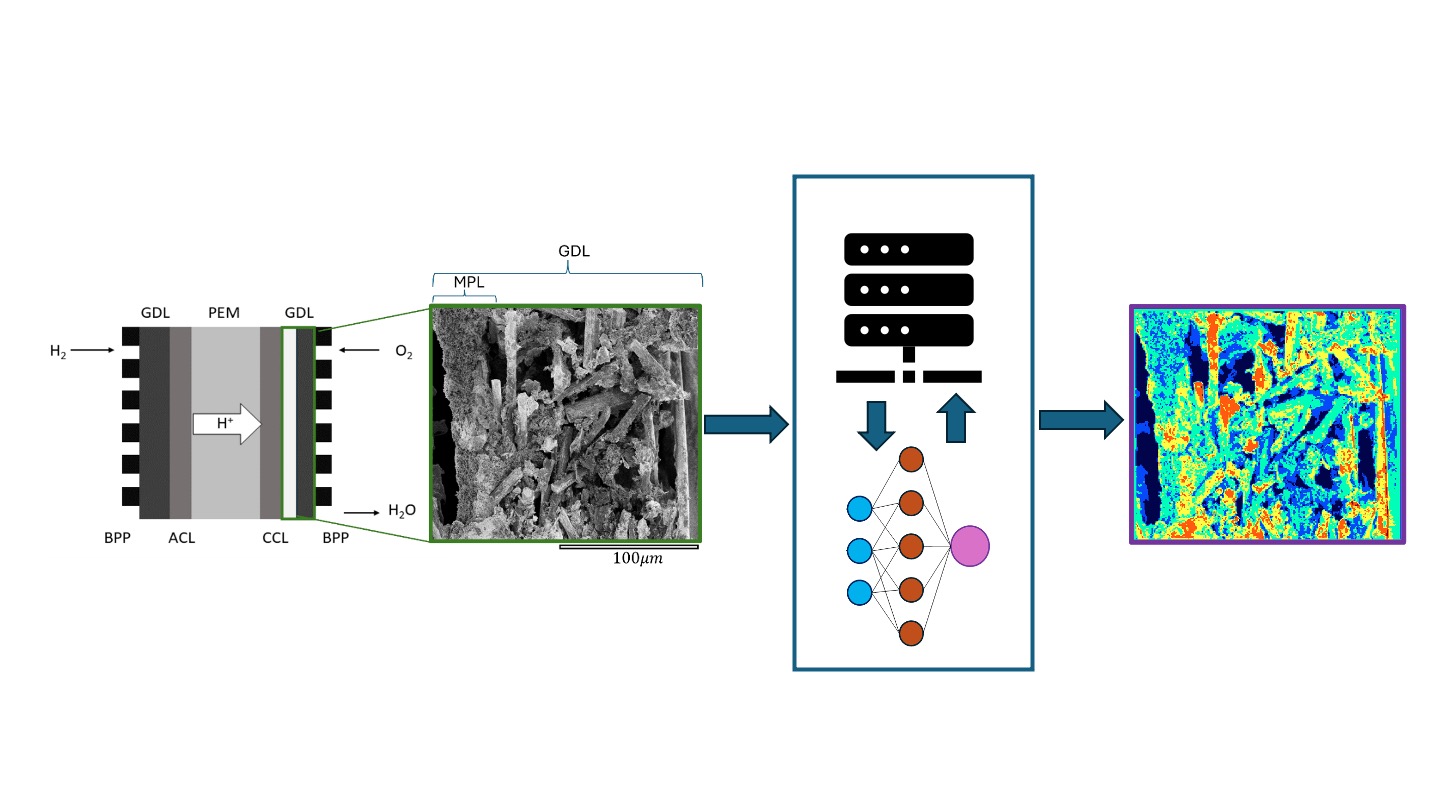
Develop a multiscale modelling framework that combines experimental imaging, high-resolution simulations, and machine learning to accurately and efficiently predict fluid transport in fuel cell porous layers, enhancing our understanding of the multiscale physics and enabling improved system-level design and performance optimization.
Background
The global shift toward sustainable energy requires rapid development of efficient hydrogen technologies, with fuel cells playing a central role. A major challenge is that key fuel cell components, such as porous transport layers, involve complex multiscale fluid and transport processes that are difficult to characterize and model. Advancing predictive modelling tools for these components can significantly accelerate innovation and strengthen Sweden’s emerging hydrogen value chain. This project addresses this need by developing a modern, physically grounded, data-driven modelling foundation that can support improved design of fuel cell systems and inspire broader interdisciplinary research in electrochemical energy technologies.
Crossdisciplinary collaboration
Collaboration between the FLOW group in the Engineering Mechanics department and the Applied Electrochemistry group in the Chemical Engineering department at KTH Royal Institute of Technology.