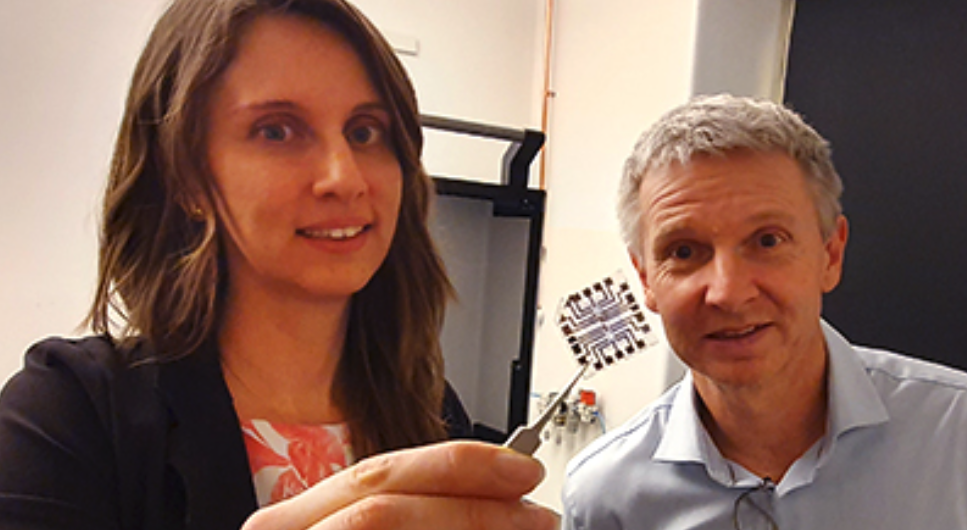
Two people stand indoors, one holding up a small, square electronic circuit on a metal tool, displaying it to the camera. Both appear interested and engaged, with a blurred background.

Innovative technique revolutionizes bioelectronics and critical sensors prototyping

A research team at KTH Royal Institute of Technology and Stockholm University has made a bioelectronics and sensor technology breakthrough. The team unveiled a fast-prototyping technique utilizing a standard Nanoscribe 3D microprinter, revolutionizing the fabrication of electrochemical transistors. Without needing cleanroom environments, solvents, or chemicals, the researchers successfully hacked 3D microprinters to laser print and micropattern semiconducting, conducting, and insulating polymers.

This novel method, reported in the journal Advanced Science, is crucial in rapidly prototyping electrochemical transistors for applications such as medical implants, wearable electronics, and biosensors.

The method can potentially substitute time-consuming processes that necessitate a costly cleanroom environment. According to Erica Zeglio, co-author of the study and a faculty researcher affiliated with Digital Futures, it also avoids using solvents and developer baths, which typically contribute to a negative environmental impact.

The applications range from monitoring living tissues to diagnosing diseases in point-of-care testing. With funding from various sources, including Digital Futures and the European Union’s Horizon 2020 program, this groundbreaking method accelerates bioelectronics research for more sustainable and cost-effective alternatives in the field.

Find out more in the article “3D microprinter hacked to fabricate transistors for bioelectronics” by David Callahan at KTH.

Photo: Erica Zeglio, left, with co-author KTH professor Frank Niklaus showing a finished transistor.
More news

A group of people in formal attire stand outside a building, smiling and holding a long blue and yellow ribbon for a ribbon-cutting ceremony. Two banners are displayed behind them.

Stockholm invigde ny AI-sandlåda för framtidens hållbara städer – Stockholm Digital Sandbox

29/05/2026

Den 29 maj invigdes Stockholm Digital Sandbox och Stockholm Urban Innovation Lab vid Kristinehovs Malmgård...

A person stands in front of a screen giving a presentation. The slide reads, Women don’t need more sympathy. We need more engineering. A laptop sits on a small stand nearby. The setting appears to be an indoor meeting room.

Breakfast seminar highlighted new technology for Home-based Hormone Diagnostics

28/05/2026

On Thursday 28 May, researchers, students and guests gathered at the Digital Futures hub for...

People are seated at tables in a modern conference room, attentively listening to a presentation titled digital futures displayed on a large screen at the front. The atmosphere is professional and collaborative.

Swedish Ministry of Finance visits Digital Futures to discuss public sector digitalization

26/05/2026

On 25 May, around 20 representatives from the Unit for Digitalization of Public Administration at...

Digital Futures Faculty Workshop explores entrepreneurship, innovation, and societal impact

26/05/2026

On 21 May 2026, around 70 researchers, innovators, entrepreneurs, and invited guests gathered at the...