Date and time: Thursday 26 February 2026, 13:00-14:00 CET
Speaker: Charlie Wilson, University of Oxford
Title: Digitalisation and AI impacts on long-term climate targets
Where: Digital Futures hub, Osquars Backe 5, floor 2 at KTH main campus OR Zoom
Directions: https://www.digitalfutures.kth.se/contact/how-to-get-here/
OR
Host: Mattias Höjer, mattias.hojer@abe.kth.se
Link to paper: Digitalisation and AI impacts on energy transitions and climate targets
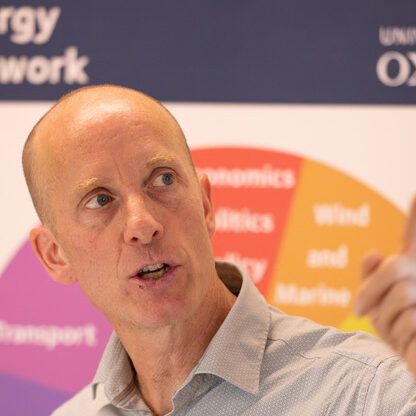
Bio: Charlie Wilson is a Professor of Energy and Climate Change and Senior Research Fellow in the Environmental Change Institute (ECI) at the University of Oxford. He is also a visiting research scholar at the International Institute for Applied Systems Analysis (IIASA) in Austria. Charlie’s research is at the intersection between innovation, people, and policy in the context of energy and climate change. He’s particularly interested in the systemic consequences of digitalisation and AI.
For January-March 2026, Charlie will be visiting KTH as a Digital Futures Scholar-in-Residence.
Abstract: Digitalisation is a double-edged sword for energy use and climate change mitigation. Digital applications can improve the energy efficiency of processes and systems, but also induce demand for energy-hungry activity. Digital infrastructure like data centres and networks also has its own energy footprint. AI is amplifying and accelerating these impacts of digitalisation on the energy transition, both for better and for worse. How does this affect the feasibility of long-term climate targets? We use a global integrated assessment model to quantify scenarios to 2050 describing alignment or misalignment between digital transformation and climate goals.
We combine empirical estimates of the energy impacts of select digital applications in buildings, transport, and industry sectors with assumptions on how fast these applications scale from innovator to later adopting regions. We also model the effect of digitalisation on energy system integration, for example, by enabling higher penetration of intermittent renewable electricity generation onto networks. We find wide uncertainty in future energy demand and resulting CO2 emissions due to digitalisation, with significant additional risk to the feasibility of Paris Agreement climate targets if induced demand is not comprehensively managed.